
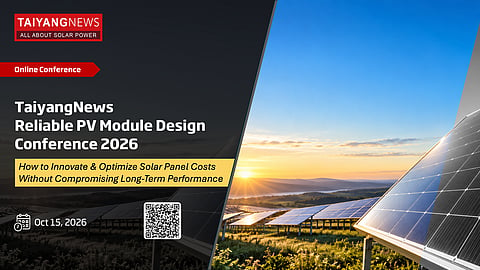

The Conference concluded with discussions on how the solar industry can improve module efficiency and power output without compromising long-term reliability.
A key takeaway was that higher performance and lower costs must go hand in hand with module quality. As PV technologies evolve, careful design, consistent manufacturing, and thorough testing will remain essential to ensure modules perform reliably throughout their operating life.
We will return with the TaiyangNews High Efficiency Solar Technologies 2026 online conference on November 11, 20, and 25, 2026 – featuring more discussions on the latest developments in high-efficiency solar cell and module technologies
During the panel discussion, Ralph Gottschalg expressed optimism about the reliability of the latest module technologies and drew on the past to show how the risks of multiple degradations were eliminated. Regarding the latest challenges and DMEGC's major achievements, René Schüler sees the high-density cemented joint as a success, while arranging junction boxes in a multi-cut TOPCon design remains a challenge. From a third-party inspection agency's perspective, Köntopp was positive about reliability improvements in new module technologies, with the caveat that module designs are reaching their limits. However, the reinsurer, Ronald Sastrawan, was less optimistic about the ease of insuring the latest module technologies, especially given the discovery of UVID in TOPCon and the advent of HJT, BC, etc.
Munich Re’s factory inspection findings show that 10% of inspected PV factories did not qualify for warranty insurance, despite having the relevant IEC certifications.
Sastrawan explained that Munich Re reviews cell and module technologies, conducts extended reliability tests, and inspects factories before providing insurance. Following reports of UV-induced degradation (UVID) in TOPCon cells, the company has also made UV60 testing and solar cell factory inspections mandatory for applicants.
Factories that fail to meet the requirements must address the identified issues before receiving insurance coverage. Sastrawan showed one example where a factory’s inspection score improved from 76% to 84% after corrective actions.
Munich Re’s Ronald Sastrawan shared an insurer’s perspective on PV module warranties at the TaiyangNews Reliable PV Module Design Conference 2026.
He pointed out that offering a 30-year warranty on a solar module is unusual. Such long warranties are important for the solar industry, as project economics depend on modules operating for 30 years or more. But they also carry risks: if a module fails to meet its guaranteed output, the manufacturer may have to compensate for the loss.
Sastrawan explained that warranty insurance covers manufacturers against large claims. He also advised buyers to ask for warranty insurance when purchasing modules, rather than assuming it is included.
René Schüler, Head of Product Marketing Europe, discussed DMEGC's latest iNFINITY RT 3.0 modules for residential, C&I, and utility applications. The full-black residential products comprise 48 and 54 G12R half-cut cells with either black or white rear encapsulant. For utility applications, the company offers its 66 cell-based 2,382 × 1,134 × 30 mm modules. The iNFINITY RT 3.0 series achieved power improvement, design upgradation, and customized design for extreme case scenarios.
Continuing his presentation, Köntopp discussed the results of TÜV Rheinland's extended reliability testing of TOPCon modules from 6 manufacturers. All 6 passed the tests, but the results varied. The biggest difference was seen in thermal cycling, where power degradation ranged from 0.43% to 4.97%, a difference of 11.6 times. In damp heat testing, degradation ranged from 0.53% to 4.68%, while UV-induced degradation ranged from 0.95% to 2.97%.
He linked these differences to module design, materials, and manufacturing processes. Despite the variation in test results, all 6 manufacturers received an AA rating in TÜV Rheinland's bankability assessment, with scores ranging from 56.0 to 76.4.
Speaking at the TaiyangNews online conference, Max Köntopp, Global Business Segment Coordinator for Power Plants at TÜV Rheinland, discussed the limitations of standard PV module certification. He explained that IEC 61215 and IEC 61730 qualification tests do not guarantee the expected 25-35-year service life of PV modules. As manufacturers introduce new cell technologies and materials, they need additional testing to assess emerging reliability risks.
To address these risks, TÜV Rheinland presented its Extended Bankability Program, which combines extended stress testing, random sampling from mass production and ongoing quality monitoring. The program covers thermal cycling, damp heat, mechanical stress, and degradation mechanisms such as PID and UVID.
Ling Zhuang, Product Manager at Trinasolar, laid out a comparison of the company's new Vertex N G3 series TOPCon module. Her presentation covered upgrades to the cells (i-TOPCon ultra), materials, product design, and testing. For example, the module incorporates the quarter-cut architecture and optimized circuit design, has triple-segment junction box, and offers improved wind-load carrying capability, among other features.
She was speaking at the TaiyangNews - All About Solar Reliable PV Module Design #OnlineConference, which is currently underway. If you haven't joined yet, here is the #FreeRegistrationLink: https://lnkd.in/gzVM_kDn
Beyond electrical insulation, JA also focused on improving the mechanical stability of its DeepBlue 5.0 modules. Mansour highlighted a redesigned rear-glass mounting-hole layout that replaces the conventional straight-line arrangement with a triangular pattern.
According to JA, this design helps distribute mechanical stress more evenly and reduces stress concentration around the mounting holes. The company reported a 14.4% reduction in hole stress during mechanical load testing. Mansour also said the redesigned module can withstand loads up to 3,200 Pa.
JA’s Product Manager, Djamel Eddine Mansour, presented the company’s high-insulation boundary sealing technology for its DeepBlue 5.0 modules at the online conference. The design uses a special sealing method that reduces the required insulation distance between the solar cells and the module edge from 10.4 mm to 3.5 mm under specified conditions. With this approach, the company aims to increase power output while maintaining electrical safety and long-term reliability.
The company uses butyl rubber to seal the module edges, which Mansour said is compatible with commonly used encapsulants. The smaller edge spacing allows larger cells to fit within the same module dimensions, increasing the active area by about 1%, according to the company. JA also reported that the design has passed a 2,400-hour aging test.
Ralph Gottschalg, Head of Fraunhofer CSP, briefly highlighted the status of rear glass fracture or breakage, which leads to subsequent warranty claims, a blame game, and delayed resolution. He shared how the glass industry can solve this problem at the production and process stages, and how the IEC standard should evolve to provide a common, acceptable resolution framework that addresses the root cause of glass fracture or breakage.
Opening the TaiyangNews Reliable PV Module Design Conference 2026, Shravan Chunduri, Head of Technology at TaiyangNews, highlighted the rapid pace of technological change in the PV industry and why reliability remains an important topic.
He noted that TOPCon, HJT, and BC technologies are already in commercial production, while next-generation TOPCon products are emerging. At the same time, module designs are becoming more application-specific. As manufacturers also focus on material optimization to reduce costs, he emphasized the need to assess how these developments affect long-term reliability, especially as module warranties extend up to 30 years.
How can PV manufacturers increase module efficiency and power output while keeping costs down without sacrificing quality or reliability?
Module designs are changing. Manufacturers are using thinner wafers, exploring new encapsulation materials, and adopting different cell and interconnection technologies. These changes can help reduce costs and improve performance, but they also bring reliability concerns.
At today's conference, industry experts will discuss what these changes mean for module quality, which reliability risks need attention, and how testing can help assess long-term performance.
The conference begins in an hour and will bring together module manufacturers, material and component suppliers, testing organizations, and industry experts.
The presentations will focus on the latest module designs, material innovations, quality and reliability challenges, and approaches to long-term performance, followed by a panel discussion.
Join us live to hear from industry experts and explore the latest developments in reliable PV module design! Free registration here.
Stay tuned for live updates from the conference!