

SpaceX and Tesla teams are separately working toward building up to 100 GW per year of solar PV manufacturing capacity in the US, says Elon Musk
The need is driven by rising AI energy demand and solar emerging as a low-cost, scalable solution with limited land needs
High tariffs have slowed solar growth in the US and Europe compared to China
SpaceX is also exploring solar power in space through plans for up to 1 million solar-powered AI satellites
Tesla has also entered solar PV manufacturing with rooftop panels made at its Buffalo factory
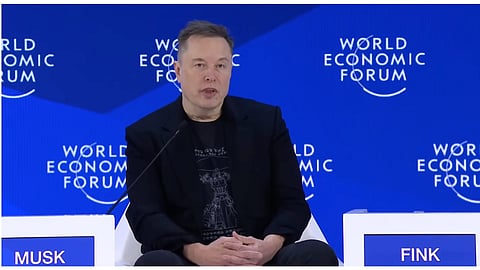
Space Exploration Technologies Corp (SpaceX) and Tesla teams are separately working on building 100 GW/year of solar PV manufacturing capacity in the US within the next 3 years, announced their Co-Founder, Elon Musk, at the recently concluded World Economic Forum (WEF).
Musk explained that interest in solar follows the strategy of using solar power to feed power-hungry AI data centers. Speaking to BlackRock CEO Larry Fink at the WEF in Davos (interview link here), Musk identified the availability of energy as a limiting factor for the AI boom, even though the cost of AI is falling rapidly.
Musk sees solar as filling this gap, and it won’t take a lot of land to produce solar power on Earth at low costs. China is able to do it, he said, with its 1,500 GW annual solar PV production capacity and over 1,000 GW of annual solar deployment. While China is the largest solar PV market globally, Musk’s 1,000 GW annual deployment in the country is way off the mark since China reported its highest annual solar PV installation capacity of 315.07 GW for 2025 (see China Sets New Annual Solar PV Installation Record In 2025).
Nevertheless, the US and Europe see limited growth for solar due to “extremely high tariff barriers” for solar panels, which make the economics of deploying solar “so artificially high”. Hence, the strategic decision to produce solar panels at scale in the US, explained Musk.
For SpaceX, interest in solar extends to space, as the company plans to launch up to 1 million solar-powered AI satellites in the coming years. It recently filed an application with the US Federal Communications Commission (FCC) seeking approval to launch up to 1 million solar-powered AI satellites.
According to Reuters, the application seeks to harness “near-constant solar power with little operating or maintenance costs” that have a lower environmental impact than terrestrial data centers.
Tesla had earlier bought the thriving solar installer and market leader SolarCity in 2016, founded by Musk’s cousins Peter and Lyndon Rive. The idea was to present a home energy solution combining solar generation with Tesla’s battery storage technology. Later, the company introduced SolarRoof and, later, a solar inverter for the US market to complete the Tesla home solar system (see Now Tesla Introduces Solar Inverter). Nevertheless, its solar deployments continued to decline over the years.
Recently, Tesla launched its own rooftop solar panel, marking its foray into solar PV manufacturing. It is reportedly producing these panels at a plant with an annual capacity of 300 MW in Buffalo, New York. The Tesla Solar Panel TSP-415 and TSP-420 come with a 25-year warranty.
