
- Markets
- Business
- People
- Opinion
- Technology
- Storage+
- Reports
- Our Events
- Tenders
- Price Index
- Top Modules
- ServicesServices
- AnalysisAnalysis

The US added 6.4 GW of new clean power capacity in Q1 2026, led by solar and battery storage
Battery storage installations reached a record 2.4 GW, up 48% from the previous Q1 high, according to a new ACP report
Texas remained the leading state for solar, wind, and energy storage deployment and development
Utility-scale solar and battery storage accounted for most of the new clean power capacity added in the US during Q1 2026, according to the latest quarterly market report from the American Clean Power Association (ACP).
Developers commissioned 6.42 GW of new utility-scale solar, battery storage, and wind capacity during the quarter, representing a 66% increase quarter-on-quarter (QoQ) and 17% year-on-year (YoY) (see US Installed Over 4 GW Utility-Scale Solar In Q1 2025).
Solar installations, however, continued to expand, leading new clean power additions with more than 3.6 GW, representing 56% of total Q1 additions. Battery storage continued its strong growth trajectory, with developers commissioning 2.4 GW of new capacity during the quarter, or 37% of new capacity. Land-based wind saw its slowest first quarter since 2018, adding about 0.4 GW.
The quarterly additions for battery storage are 48% higher than the previous 1st-quarter record set in 2025. ACP says this is the 4th consecutive year in which Q1 storage deployments have set a new record.
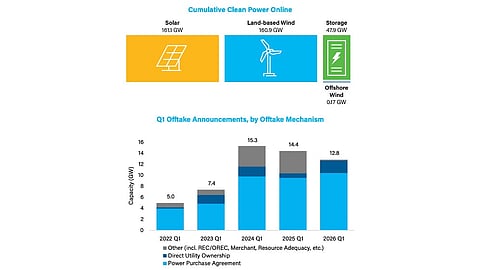
With these new installations, the total operational clean power capacity in the US expanded to more than 370 GW, which the association says is enough to power nearly 80 million homes. Utility-scale solar capacity leads the pack with 161.1 GW aggregate capacity by the end of the quarter, slightly surpassing land-based wind capacity of 160.8 GW. Battery storage capacity stood at 47.9 GW, while offshore wind capacity was 0.17 GW.
Analysts, however, highlight project delays as one of the roadblocks to clean energy expansion in the country. It says developers majorly attribute these delays to lengthy permitting schemes, backlogged interconnection queues, and fluctuating prices for key project equipment.
More than 6.4 GW of clean power capacity was expected to come online in the reporting quarter, but project delays pushed it into a backlog that has now reached 53 GW, as per the report.
At the end of the reporting quarter, the US clean power development pipeline expanded to 195 GW by the end of Q1 2026, supported largely by growth in battery storage projects. The storage pipeline increased 17% QoQ to a record 53.8 GW, while utility-scale solar projects under development reached 103.4 GW.
In contrast, both land-based and offshore wind pipelines declined as projects faced permitting challenges and regulatory delays.
“Clean energy projects are the fastest to deploy as American electricity demand rises and energy prices increase,” said ACP Chief Policy Officer JC Sandberg. “Unfortunately, American families are footing the bill for the politicized bureaucracy that has halted wind projects aimed at powering millions of homes and keeping costs low. Americans need policies that speed clean energy deployment, not delay it,” he added.
Texas remained the country's leading clean energy market, adding 1.6 GW of new capacity during the quarter and overtaking California in operational battery storage. The state also maintained the largest operational and development portfolios for utility-scale solar, land-based wind, and energy storage.
Meanwhile, clean power offtake announcements totaled 12.8 GW in Q1 2026, down from 14.4 GW a year earlier. Power purchase agreements (PPAs) remained the dominant procurement method, accounting for 10.4 GW, or 81% of announced capacity, marking a record 1st quarter, supported by major procurement deals from companies including Google and Xcel Energy.
ACP’s Q1 2026 Clean Power Quarterly Market Report is available on its website.
The association recently published its clean energy manufacturing report for the US market, which indicates more than 950 such facilities are likely to come online in the country by 2030. It claims the US now has enough domestic production capacity of solar modules and battery storage modules to meet the demand (see ACP: US Adds 60+ Solar & Storage Factories In 2025).
