
- Markets
- Business
- People
- Opinion
- Technology
- Storage+
- Reports
- Our Events
- Tenders
- Price Index
- Top Modules
- ServicesServices
- AnalysisAnalysis

A 4-terminal (4T) silicon-perovskite tandem cell achieved 30.2% efficiency using a 25.5%-efficient n-type TOPCon bottom cell
Voltage recovery in transparent perovskite cells is primarily governed by interfacial defect suppression rather than band alignment
An ion-modulated, post-oxidation-free spiro-MeOTAD HTL reduced Shockley-Read-Hall (SRH) recombination across multiple perovskite bandgaps, the research shows
Silicon-perovskite tandem solar cells continue to push efficiencies beyond the limits of single-junction silicon. While 2-terminal (2T) architectures have reported efficiencies approaching 35%, 4-terminal (4T) configurations offer a practical pathway toward integration into modules and independent sub-cell operation. In 4T designs, the perovskite top cell and silicon bottom cell operate separately, enabling replacement of the perovskite sub-cell in case of degradation without affecting the silicon device.
In a recent study published in EES Solar under the title “Bandgap-tunable transparent perovskite solar cells for 4T Si/perovskite tandem photovoltaics with PCE > 30% via rational interface management,” researchers from the Indian Institute of Technology (IIT) Bombay, reported a 4T silicon–perovskite tandem solar cell device with 30.2% efficiency. The device integrates an optimized transparent perovskite top cell with an n-type TOPCon silicon bottom cell with 25.5% efficiency.
Bandgap tuning is essential for optimizing spectral utilization in tandem systems. However, increasing or decreasing the perovskite bandgap often leads to open-circuit voltage (VOC) deficits. While such losses are frequently attributed to energy-level misalignment at the charge-transport interfaces, the study examines whether this assumption holds.
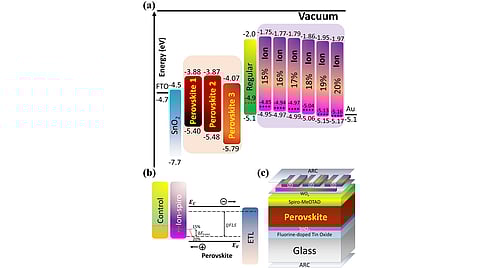
The researchers focused on the hole transport layer (HTL), which plays a key role in extracting charge carriers from the perovskite absorber. Conventional devices rely on chemically doped spiro-MeOTAD, a widely used organic HTL that requires post-oxidation processing and can introduce interfacial instability. This HTL was replaced with a post-oxidation-free, ion-modulated version of spiro-MeOTAD incorporating TBMPTFSI salt. The modified HTL enabled controlled tuning of the work function and significantly suppressed non-radiative recombination losses at the interface. The analysis showed that this corresponds to a reduction in Shockley-Read-Hall (SRH) recombination, a dominant voltage loss pathway in perovskite devices.
In the study, 3 perovskite compositions were evaluated, with bandgaps of 1.52 eV, 1.61 eV, and 1.72 eV. For the 1.52 eV device, replacing the conventional HTL improved VOC by approximately 50 mV and increased efficiency from 18.2% to 21.3%. For the 1.72 eV composition, efficiency improved from 14.4% to 16.1%, accompanied by measurable Voc gains. In contrast, the 1.61 eV device showed only marginal changes, indicating near-optimal interfacial properties even with the conventional HTL.
Carrier lifetime measurements indicated a significant reduction in SRH recombination with the ion-modulated HTL.
The optimized transparent perovskite cells were integrated in a mechanically stacked 4T configuration with a monocrystalline n-TOPCon silicon bottom cell. Depending on the perovskite bandgap, tandem efficiencies of 30.2%, 29.4%, and 28.4% were obtained. The highest result, 30.2%, represents an ~18% relative improvement over the standalone silicon cell. According to the authors, the performance is among the highest reported for transparent perovskite-based 4T tandems evaluated on an active area.
Beyond efficiency gains, the ion-modulated spiro-MeOTAD removes the need for prolonged post-oxidation steps typically required in LiTFSI- and tBP-doped systems. Conventional formulations rely on oxidation processes that take 10 to 24 hours and use hygroscopic dopants that can compromise long-term stability.
The ion-modulated spiro-MeOTAD approach improved Voc by 2-5% and FF by 6-7% for off-optimum bandgaps, while enabling a 4T tandem device with 30.2% efficiency, representing an ~18% relative improvement over standalone silicon.
The study highlights a key design principle for bandgap-tunable transparent perovskite top cells: managing interfacial recombination is more critical than achieving perfect energy level alignment. As perovskite bandgaps are adjusted to optimize current matching or spectral splitting in tandem architectures, defect tolerance at the HTL/perovskite interface becomes a decisive factor in voltage retention.
