
- Markets
- Business
- People
- Opinion
- Technology
- Storage+
- Reports
- Our Events
- Tenders
- Price Index
- Top Modules
- ServicesServices
- AnalysisAnalysis

The study introduces a ligand-based interfacial engineering approach that improves interfacial uniformity and chemical stability
Using this strategy, the researchers achieved 25.4% efficiency in 1.1 cm² inverted perovskite solar cells
Under continuous maximum power point operation at 85 °C and 1-sun illumination, the devices retained more than 95% of their initial performance after 1,100 hours
In a joint research and development effort aimed at addressing long-standing stability challenges in perovskite solar cells, researchers from the participating universities reported a set of findings that have been published in a paper titled ‘Multivalent ligands regulate dimensional engineering for inverted perovskite solar modules’ by Xiaoming Chang et al. in Science.
Among the prominent names part of the research team are Prof. Randi Azmi from the Chinese University of Hong Kong, Shenzhen, and Thomas Anthopoulos, Professor of Emerging Optoelectronics at The University of Manchester.
Widely regarded as a next-generation photovoltaic technology, perovskite solar cells have been limited by instability under heat and illumination. The research team addressed this by fine-tuning the perovskite interface to improve durability and charge transport. The study introduces an interfacial engineering strategy based on multivalent amidinium ligands that enables the controlled formation of thin, low-dimensional perovskite capping layers on the conventional 3-dimensional absorber. By directing whether 1-dimensional (1D) or 2-dimensional (2D) layers form at the interface, the approach avoids discontinuous coverage and improves interfacial chemical stability.
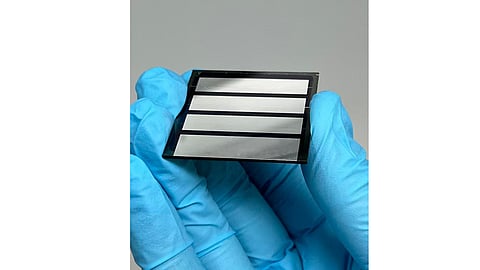
Using this interfacial design strategy, the researchers achieved a certified power conversion efficiency of 25.4% on 1.1 cm² inverted perovskite solar cells. The approach was also demonstrated at a module-relevant scale, with 4-cell mini-modules reaching efficiencies above 24%. Under continuous maximum power point tracking at 85°C and 1-sun illumination, the devices retained more than 95% of their initial performance after 1,100 hours.
According to the researchers, the rule-based ligand design framework moves beyond empirical trial-and-error approaches and enables more predictable control of interfacial stability. They believe the method could support scalable manufacturing and accelerate the development of stable inverted perovskite solar cells for tandem and standalone photovoltaic applications.
