
- Markets
- Business
- People
- Opinion
- Technology
- Storage+
- Reports
- Our Events
- Tenders
- Price Index
- Top Modules
- ServicesServices
- AnalysisAnalysis
Key takeaways:
The Solar Stewardship Initiative’s ESG and traceability standards are developed to streamline assessments and improve supply chain transparency
SSI membership now represents 70% share of global module production, driven in part by upcoming regulatory requirements in major markets
New SSI tools, certification timelines, and traceability targets aim to support consistent compliance across manufacturers and regions
At the TaiyangNews Solar & Sustainability conference, Rachel Owens, CEO of the Solar Stewardship Initiative (SSI), outlined the organization’s purpose, structure, and recent developments in its transparency and traceability work across the global PV supply chain.
The SSI, now in its third year, was established as a global accountability initiative dedicated to the solar sector, operating through a multi-stakeholder model that brings together manufacturers, buyers, investors, civil society, human-rights experts, and trade associations. This model is reflected in its governance, where industry and non-industry groups have equal representation. The SSI aims to create harmonized environmental, social, governance (ESG) and traceability standards for the industry, aligned with international frameworks such as ILO conventions, the UN Guiding Principles, and OECD guidelines.
Owens explained that a central part of SSI’s work is its independent, third-party auditing system, developed to reduce the audit burden on manufacturers who previously faced numerous overlapping assessments from buyers. The SSI’s ESG and traceability standards are broad, covering environmental, social, governance, and supply chain transparency criteria.
The ESG standard, published in October 2023, contains around 100 requirements and currently certifies 12 sites representing roughly 95-100 GW of manufacturing capacity. Certifications are awarded at gold, silver, or bronze levels depending on the severity of non-conformities.
The supply chain traceability standard, published in late 2024, evaluates traceability from module production back to quartz mining. The first assessments under this standard are underway, with certifications expected in 2026.
SSI Membership has expanded to include major manufacturers, particularly in China, as well as European producers, buyers, investors, and trade associations. The members now represent roughly 70% of global module manufacturing capacity. Owens noted growing engagement from polysilicon manufacturers, development finance institutions, and stakeholders in regions preparing for new regulatory requirements. Upcoming EU legislation, including the Forced Labor Regulation and the Corporate Sustainability Due Diligence Directive (CSDDD), was highlighted as a major driver of demand for SSI certification, as companies seek tools to demonstrate compliance. The SSI is also working to globalize adoption, including in emerging production hubs such as India.
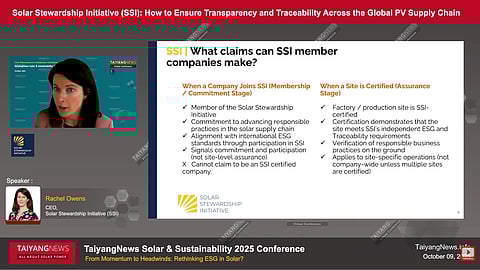
Owens detailed the distinction between SSI membership and certification: joining SSI signifies a commitment to its principles, but manufacturers must undergo site-level audits to be considered certified. Members are required to submit at least 2 sites for ESG and traceability standards assessment within the first 24 months of membership. If there is only one site, then the assessment for both ESG and traceability must be done within 12 months of membership. The organization has recently adopted targets requiring all module capacity shipped to Europe and the UK by SSI members must come from SSI-certified sites by 2028. It has made new tools available, including a digital transparency platform and a Buyer’s Guide to support the implementation and communication of certification progress.
She concluded by emphasizing the role of SSI in addressing allegations of forced labor and ESG risks reported in earlier years, and the importance of robust traceability systems to maintain confidence in the solar industry amid increasing political scrutiny. The SSI positions itself as a unified response to these concerns, offering harmonized standards, credible auditing, and multi-stakeholder governance to support a responsible and transparent solar supply chain.
Here is a link to the full presentation by Rachel Owens: Ensuring PV Supply Chain Transparency & Traceability.

