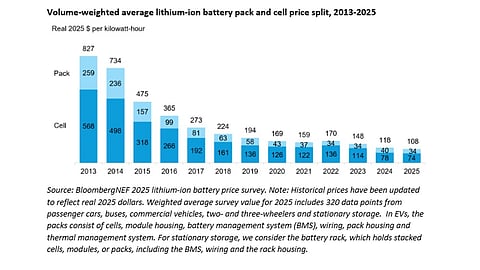


Global lithium-ion battery pack prices dropped 8% YoY to $108/kWh in 2025, despite higher lithium and cobalt costs, says BloombergNEF
Stationary storage saw the steepest decline, with pack prices falling to $70/kWh, making it the cheapest segment for the first time
China recorded the lowest prices and the biggest decline, while North America and Europe remained significantly more expensive due to higher production costs, imports, and policy impacts
As battery storage becomes a key piece of the energy transition puzzle, Bloomberg New Energy Finance (BloombergNEF) says lithium-ion battery pack prices reached a record low of $108/kWh, having fallen 8% year-on-year (YoY) since 2024.
The decline was despite an increase in battery metal costs during 2025 due to supply risks at certain Chinese lithium assets and new cobalt export quotas in the Democratic Republic of Congo (DRC). Lower battery prices can support the adoption of storage in the renewable energy segment so as to support the intermittency of solar and wind power. It can also help with curtailment and stabilize grids.
In its 2025 Lithium-Ion Battery Price Survey, BloombergNEF says the price decline was registered primarily due to continued cell manufacturing overcapacity, intense competition, and the ongoing shift to lower-cost lithium iron phosphate (LFP) batteries.
China, the world’s largest LFP producer, has been producing more cells than needed for its domestic electric vehicle (EV) and stationary storage demand, which the analysts say has created intense competition among manufacturers. Its impact is majorly visible in the stationary storage sector since here many suppliers can serve the same projects.
Pricing, however, differs across use cases since every sector requires different cells and packs to meet distinct performance metrics, points out BloombergNEF.
The sharpest drop across all segments was seen in stationary storage as battery pack prices dropped to $70/kWh in 2025, 45% lower than in 2024, making it the lowest-priced segment for the first time.
In the transport segment, battery EV (BEV) packs were the cheapest at $99/kWh. This was the 2nd year their price was recorded under the $100/kWh threshold.
The average LFP battery pack prices across all segments came in at $81/kWh, while nickel manganese cobalt (NMC) packs were at $128/kWh.
China had the lowest average price at $84/kWh in 2025. Prices in North America were 44% to 56% higher, respectively, compared to those in China. BloombergNEF links this to higher local production costs and reliance on imports. China also saw the largest price drop, at 13% in real terms. Prices fell by 4% in North America and 8% in Europe. Europe’s price decline was larger than North America’s due to US policy and tariffs. Many Chinese suppliers shifted exports to Europe and used aggressive pricing, point out the analysts, thus increasing competition in the European market.
“Cut-throat competition is making batteries cheaper every year. This is an important moment for the industry, as record-low battery prices create an opportunity to lower EV costs and accelerate the deployment of grid-scale storage to support renewables integration around the world,” said Evelina Stoikou, who heads BloombergNEF’s Battery Technology team.
The market intelligence agency expects pack prices to decrease further in 2026 as low-cost LFP adoption continues to spread, even as raw material prices go up.
“Over the longer term, ongoing investment in R&D, manufacturing efficiency and supply chain expansion is expected to support further technology improvements and cost reductions. Emerging technologies, including silicon and lithium metal anodes, solid-state electrolytes, new cathode materials and new cell manufacturing processes, are also set to play a key role in driving the next wave of price declines,” it adds.
The complete BloombergNEF survey is available to its clients on its website.
TaiyangNews is bringing together leading industry stakeholders for the 2nd edition of the Inverters & Battery Storage Conference on December 16, 2025. Experts in the field will explore the crucial role of inverters and batteries in building resilient and responsive energy systems based on solar power. Registrations to this virtual conference are free, here.
