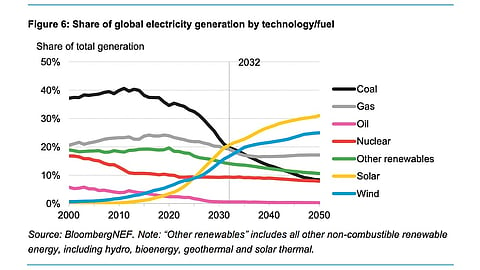


BloombergNEF projects solar to become the world’s largest electricity generator by 2032
Global battery storage deployment is forecast to grow from 223 GW in 2025 to 3.8 TW by 2035
Data centers, EVs, and electrification are expected to drive a sharp rise in global electricity demand
Bloomberg New Energy Finance (BloombergNEF) projects that solar energy will become the world’s largest zero-carbon power source by 2030 and the largest source of electricity generation by 2032, driven by falling prices and expanding manufacturing overcapacity.
It attributes growing demand for electric vehicles (EVs), data centers, population growth, and industrial activity to spur electricity demand, which the world would like to meet with the most efficient, least-cost technologies, according to BloombergNEF’s New Energy Outlook 2026 (NEO).
Worldwide data center capacity reached 84 GW in 2025, consuming 500 TWh or 1.9% of global total electricity demand – a 20% year-on-year (YoY) growth.
By 2050, data centers will need more than double the electricity supply, at 1,114 TWh or 3.6% of total demand. It will be 1/10th of the global electricity demand.
According to BloombergNEF’s least-cost modeling, by 2050, data center demand could drive a major capacity expansion for electricity supply, requiring 1,000 GW of utility-scale solar, 400 GW of batteries, 370 GW of gas, and 110 GW of coal capacity.
Although fossil-fuel plants would account for only about 20% of new capacity additions, they are expected to supply around 51% of the extra electricity needed for data centers, including from new gas plants and coal plants operating longer than expected.
EVs are also reducing oil demand, but the biggest cut in carbon emissions comes from replacing coal power with renewables, batteries, and some gas generation. Under stricter net-zero pathways, both oil and gas demand decline over time.
Solar deployment has already surged from 75 GW in 2016 to reaching 655 GW in 2025. It will continue the record annual build rate, also thanks to various micro-system applications as well as large-scale systems, but will not grow dramatically over the next several years.
Solar has already disrupted power markets in regions with high adoption, lowering midday electricity prices and reducing revenues for traditional power generators. Batteries are emerging as a simpler solution by storing excess daytime solar power for evening use. Falling battery prices are driving rapid growth in energy storage deployments.
Analysts see strong growth in battery storage, with installed capacity projected to increase almost 17-fold to 3.8 TW by 2035, up from 223 GW in 2025, as countries strengthen grid flexibility and energy security, though growth will vary by country. However, batteries face economic and technical limits as renewable penetration increases. Longer-duration storage technologies are still developing and have not yet reached large-scale deployment, analysts highlight.
“NEO shows that solar becomes the world’s largest generator overall by 2032, while storage jumps 17-fold to 3.8 terawatts by 2050, underscoring how clean technologies are increasingly critical to energy security, system flexibility and meeting the world’s growing power needs,” said BloombergNEF Head of Energy Economics, Matthias Kimmel.
Global energy transition investment reached a record $2.3 trillion in 2025, but analysts estimate far more investment is needed to meet net-zero goals by 2050, with most spending required for low-carbon technologies.
Going by the world’s continued investment in fossil fuels, BloombergNEF believes a global warming scenario well below 2°C is still achievable, although the chance of limiting warming to 1.5°C has passed. Clean energy technologies could still help keep the temperature rise to around 1.81°C, but it requires much higher annual clean energy investment to meet climate goals, higher than a record $2.3 trillion in 2025.
An executive summary of the report is available for free download on BloombergNEF’s website.
