

Borosil Renewables says its revenue, EBITDA, and margins improved in Q1 FY27
It attributes the improved financials to higher solar glass prices, renewable power usage, and capacity expansion
The company also reported that its R&D unit secured DSIR recognition, valid through March 2029
Indian solar glass manufacturer Borosil Renewables reported a return to profitability during Q1 FY27 (ended June 30, 2026), with higher revenue and operating earnings. It has also announced plans to venture into the rooftop solar business.
On a standalone basis, its revenue increased 22.1% year-on-year (YoY) to INR 405.7 crore for the quarter, while EBITDA rose 53.5% to INR 142 crore. Its EBITDA margin expanded to 35% from 27.8% a year earlier. According to the company, its EBITDA margin remained above 33% for the 4th consecutive quarter.
The company posted a profit after tax (PAT) of INR 87.7 crore, compared with a loss of INR 272.3 crore in the corresponding quarter last year.
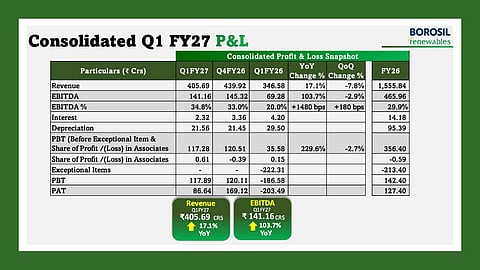
On a consolidated basis, its revenue grew 17.1% YoY to INR 405.7 crore, while EBITDA more than doubled to INR 141.2 crore, with EBITDA margin improving to 34.8% from 20% a year ago. Its consolidated PAT stood at INR 86.6 crore, compared with a loss of INR 203.5 crore in the year-ago period.
According to the company's investor presentation, the revenue improvement was largely driven by higher average ex-factory selling prices for solar glass, which increased to INR 160.3/mm during the quarter, compared to INR 138.1/mm a year earlier and INR 150.2/mm in Q4 FY26.
The company said the selling price included a fuel surcharge introduced in March 2026 to offset higher fuel costs following the conflict in West Asia.
Borosil Renewables said its newly commissioned solar-wind hybrid captive power plant increased the share of renewable energy in its electricity consumption to 93% during the quarter, helping lower costs and reduce the environmental footprint of its operations.
Providing an update on its expansion plans, management said that work on its planned 600 tons per day (TPD) solar glass capacity expansion through two new furnaces (300 TPD each) remains on schedule, with commissioning slated for December 2026.
The project involves an estimated investment of INR 950 crore and is intended to meet growing domestic demand for solar glass following anti-dumping duties (ADD) on imports from China and Vietnam (see India Imposes Anti-Dumping Duty On Imported Solar Glass).
Borosil Renewables has also entered the distributed solar segment with its rooftop solar division. It will offer branded solar panels with over 600 W capacity, inverters in the 3-150 kW range, and lithium batteries ranging from 12.8 V to 51.2V. As a ‘low-risk entry’ strategy, it plans to initially opt for co-branded execution as a pilot before making white-label investment.
The move, it explained, is part of end-to-end rooftop solar solutions the company plans to offer for residential and commercial & industrial (C&I) customers. The initial focus of the rooftop business will be on the states of Gujarat, Rajasthan, and Uttar Pradesh.
Earlier this month, Borosil Renewables clarified a media report published by a local business news portal regarding rumors of strategic investment talks. In a filing with the stock exchange, it said that it routinely explores strategic opportunities as part of its business strategy and would make disclosures if and when required.
Separately, in June, Borosil Renewables announced that its in-house research and development facility in Pune had received recognition from the Department of Scientific and Industrial Research (DSIR). The recognition, valid until March 31, 2029, enables the company to claim customs duty exemptions on imported R&D equipment, instruments and consumables used for research activities.
