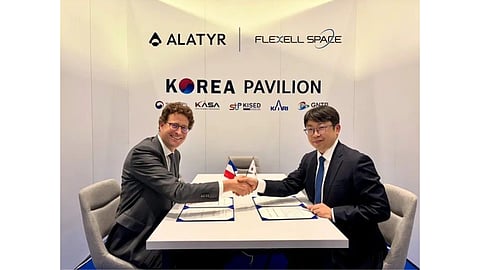


Flexell Space has signed an MoU with ALATYR to explore solar power solutions for orbital data centers
The partners plan to assess solar cell compatibility with the power requirements and operating conditions of orbital data centers
Flexell Space is developing lightweight solar cells based on CIGS and perovskite technologies for space applications
South Korean space solar cell developer Flexell Space has signed a memorandum of understanding (MoU) with France’s ALATYR, a developer of orbital data centers. Under the partnership, the two companies plan to explore the use of Flexell Space’s solar cell technology to power computing and data storage facilities in space.
Apart from efficiency, the weight of solar cells and their service life are important considerations for such applications. As data centers in space grow in size, the cost of manufacturing, launching and deploying solar power systems will also need to be taken into account.
Starting with an exchange of technical information, the partners will assess the suitability of Flexell Space technology based on the power requirements and operating conditions of ALATYR’s orbital data centers. The scope of joint development and validation will be decided through further technical discussions.
Flexell Space started as an internal venture at Hanwha Systems. It works with copper indium gallium selenide (CIGS) and perovskite solar cell technologies, with a focus on reducing the weight and cost of solar cells for space applications.
According to the company’s website, its perovskite-CIGS tandem cells have an efficiency range of 28% to 30%. Flexell Space claims a weight reduction of over 90% and cost savings of at least 60% compared to conventional space solar cells. Its product roadmap includes rigid solar cells, flexible solar cells, and deployable solar modules.
ALATYR’s approach to building data centers in space is based on the different lifetimes of computing hardware and the infrastructure supporting it. While the company expects to replace computing hardware every 3 to 5 years, the supporting infrastructure has a planned lifetime of over 15 years. Its CITADEL modular architecture and BYLD robotic system are intended to facilitate hardware replacement, maintenance and assembly in orbit.
The challenges of developing solar cells for space applications were also discussed on Day 3 of the TaiyangNews High-Efficiency Solar Technologies Conference 2026. Besides improving the power-to-weight ratio, researchers and manufacturers are working on reducing radiation-induced degradation and adapting cell and module materials to withstand frequent temperature changes in space (see High-Efficiency Solar Technologies 2026 – Day 3: Space PV).