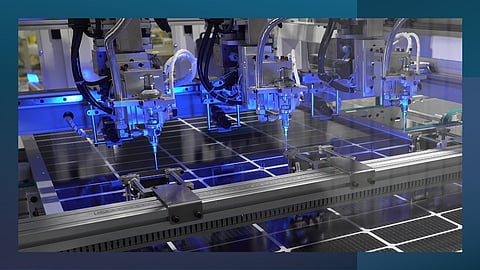


Oswal Pumps plans to establish a 1.2 GW TOPCon solar cell manufacturing facility
It expects the investment to reduce its dependence on external suppliers and improve cost competitiveness
It will be funded through debt and the reallocation of previously earmarked IPO proceeds
Oswal Pumps Limited has unveiled plans to establish a 1.2 GW solar cell manufacturing facility using tunnel oxide passivated contact (TOPCon) technology. The management said this investment will expand its manufacturing operations beyond solar modules and pumping systems.
The board of its wholly owned subsidiary, Oswal Solar Energy Private Limited (OSEPL), approved the proposal on October 10, 2026. Commercial production at the facility is expected to begin by April 2028.
The company intends to use the entire output for its in-house solar module manufacturing lines, securing supplies of domestically manufactured cells for projects that require compliance with domestic content requirements (DCR).
Oswal Pumps said it evaluated long-term supply arrangements with domestic cell manufacturers but found the available commercial terms, including pricing and upfront security deposits, unsuitable for its long-term plans and working capital management.
The company identified cell manufacturing as a priority because domestic cell availability is a constraint for its operations serving programs such as PM-KUSUM and PM Surya Ghar.
“With ALMM List-II now in force, demand for domestically manufactured cells is set to rise sharply. We see this as the right opportunity to invest. Choosing TOPCon technology ensures we are building for the future, with higher efficiency and better long-term performance for our customers,” stated Oswal Pumps Limited Chairman and Managing Director Vivek Gupta.
According to the company, the TOPCon project will cost an estimated INR 456 crore, of which about INR 296 crore is proposed to be financed through debt. The remaining INR 159.85 crore is expected to come from unutilized IPO proceeds of INR 163.04 crore. This was originally allocated to other manufacturing facilities, namely aluminum frame facility, 300 MW EVA encapsulant facility, and 500 MW solar module factory.
The company said its planned cell production will suffice its existing module production capacity of around 570 MW and planned module capacity of 1 GW. Its 1.2 GW EVA encapsulant capacity is also sufficient to support the production of solar modules. It can source any additional requirement for EVA as well as aluminium frames from the market.
It expects the cell facility to reduce the company’s exposure to spot-market price fluctuations, supplier terms and potential supply constraints.
