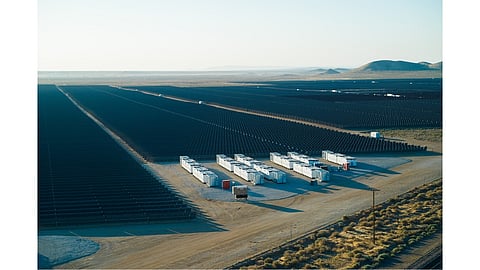


IRENA has issued a policy advisory to accelerate renewable energy deployment for global energy security and resilience
It lists falling costs and strong economics—especially for solar, wind, and storage—that make renewables the cheapest option for new power in most cases
It sets out a phased policy roadmap, urging immediate deployment support, faster project execution, and long-term structural reforms
A new policy advisory issued by the International Renewable Energy Agency (IRENA) recommends urgent targeted interventions for the world to accelerate the deployment of renewable energy, taking a cue from the current escalating energy crisis unfolding globally.
With the global oil and gas supply disrupted due to the conflict in the Middle East, countries must use renewables to steer their economy towards greater energy security and resilience, argues the agency.
IRENA bats for renewable energy with its economics. Solar PV costs have come down by 87% since 2010, onshore wind by 55% and battery storage by 93%. Solar PV leads renewable energy additions globally with over 510 GW deployed in 2025 (see IRENA: Global Solar PV Additions Exceeded 510 GW In 2025).
“Almost all newly commissioned utility-scale renewable capacity (91% as of 2024) delivers power at a lower levelised cost of electricity (LCOE) than the cheapest, newly installed fossil fuel-based alternative,” according to IRENA’s assessment.
Solar-plus-storage systems are today competitive at $54 to $83/MWh, while wind-plus-storage configuration costs $59 to $94/MWh. On the other hand, cost of new coal-fired generation in China ranges within $70 to $85/MWh. Solar PV-battery hybrid mini-grids can reduce diesel consumption by up to 80%, while limiting LCOE increases to around 10% to 15%.
According to BloombergNEF, the global benchmark cost for a 4-hour battery project fell 27% year-on-year to $78/MWh in 2025. Around 87 GW of combined solar and storage projects last year were installed at an average of $57/MWh (see Battery Storage Project Costs In 2025 Dropped To Record Lows Since 2009).
IRENA cites the examples of countries like Spain and Portugal that have managed to bring down natural gas imports with the expansion of solar, wind and battery installations. Pakistan is another country where it says decentralized solar and storage, along with increased deployment of EVs has reduced the country’s dependence on imported fuels.
Cuba too has been scaling up distributed renewable energy with community solar and battery, especially in off-grid locations to support agricultural activities. With China supporting Cuba in its energy sector including supplying solar PV systems for distributed generation, TaiyangNews forecasts the country to reach 2 GW cumulative solar PV capacity by 2028 (see Solar Revolution In Cuba Amid Fuel Shortage And Nationwide Blackouts).
“The current crisis clearly demonstrates the strategic case for renewables as a national security imperative,” said IRENA Director-General Francesco La Camera. “There is an opportunity to prioritise actions that enhance long-term energy stability.”
The policy advisory titled From Energy Crisis to Energy Security Actions for Policy Makers recommends actions for policy makers in the short-term (0-6 months), medium-term (6 to 12 months), longer-term (1-3 years).
Over the next 6 months, governments can deploy distributed renewable energy solutions to support public services and community responses, while providing financial and logistical support to fast-track deployment. Accelerating solar PV battery hybrid mini-grids in both off-grid and weak-grid remote areas, fast-track time-of-use tariff adoption to enable customers to shift their electricity consumption to periods when renewable energy supply to the grids is higher, and implementing grants, subsidies or tax rebates and other incentives to speed up electrification.
In the medium-term, IRENA recommends fast-tracking current renewable energy and grid infrastructure projects, incentivizing battery energy storage system (BESS) deployment, leveraging grid enhancement technologies to relieve near-term grid constraints, among other actions.
Going forward, over the long-term, the policymakers must establish clear, supportive and comprehensive policy frameworks for energy transition, promote domestic and regional supply chain development for renewables to reduce import dependency, and facilitate hybridization of projects with storage systems. They must also make financial and subsidy support for fossil-fuel industry conditional on meeting renewable energy targets.
