

Renewables avoided an estimated $480 billion in fossil fuel costs and 8.4 gigatonnes of carbon emissions in 2025, according to a new IRENA report
Global renewable capacity additions exceeded 690 GW in 2025, led by solar PV and wind
IRENA expects renewable power costs to continue declining through 2035, although at a slower pace
Renewable energy remained the lowest-cost source of new electricity in most markets in 2025, with its cost advantage over fossil fuels continuing to widen, according to the latest cost report from the International Renewable Energy Agency (IRENA).
Installed renewable capacity also helped avoid an estimated $480 billion in fossil fuel costs and 8.4 gigatonnes of CO₂ emissions in 2025, according to IRENA's Renewable Power Generation Costs in 2025 report. Existing renewable generation in Indonesia, Thailand, and the Philippines also helped avoid about $5.7 billion in coal and gas purchases during the year.
China accounted for $177 billion, or nearly half of the global fossil fuel cost savings, reflecting the scale of its renewable energy fleet. The US avoided $35 billion in fossil fuel costs; Brazil, $32 billion; India and Germany, $18 billion each; and Japan, $15 billion. “The geographic distribution of economic benefits closely mirrors the global distribution of renewable energy capacity,” it underlines.
Across 20 major economies, representing about 4/5ths of global renewable electricity generation, renewable power avoided an estimated $377 billion in fossil fuel purchases in 2025.
IRENA said renewables acted as a ‘geopolitical shock absorber’ by reducing exposure to volatile fossil fuel markets.
The report found that more than 90% of utility-scale renewable capacity commissioned in 2025 generated electricity at a lower cost than the cheapest newly built fossil fuel alternative.
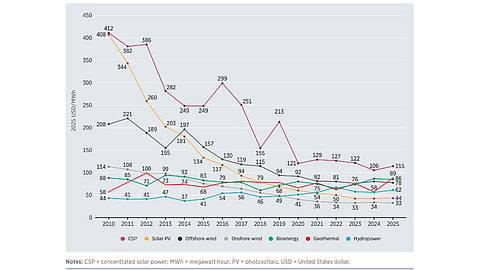
Meanwhile, the gap between renewable energy costs and fossil fuels continued to widen. Solar PV's global weighted average levelized cost of electricity (LCOE) remained unchanged at $44/MWh, while onshore wind declined 4% to $33/MWh and offshore wind fell 3% to $78/MWh.
Since 2010, the cost of solar PV has fallen by 89%, onshore wind by 71%, offshore wind by 63%, and concentrating solar (CSP) by 72%. The LCOE of new gas-fired generation approached $100/MWh in higher gas-price markets such as Italy, Germany, and Japan.
The report links the financial benefits to higher fuel prices following the temporary closure of the Strait of Hormuz in early 2026.
“The decline in renewable energy costs is delivering a powerful economic dividend,” said IRENA Director-General Francesco La Camera. “This energy crisis (owing to closure of the Strait of Hormuz in early 2026) has shown yet again: expanding renewable capacity is a strategic investment in resilience and competitiveness.”
According to IRENA, global renewable capacity additions exceeded 690 GW in 2025, around 1/5th higher than in 2024. Solar PV accounted for more than 500 GW of new installations, while wind contributed about 160 GW.
Asia remained the largest deployment region, with China accounting for nearly 2/3rds of new solar capacity and around 3/4ths of new wind additions.
IRENA highlights the role of falling battery storage costs in improving the economics of hybrid renewable energy systems. The firm LCOE of high-reliability solar-plus-battery systems fell from more than $100/MWh in 2020 to below $85/MWh in 2025, with further declines of around 30% by 2030 and 40% by 2035 projected. The installed cost of 4-hour utility-scale batteries also dropped nearly 30% in 2025 to around $140/kWh, while about 25% of new utility-scale solar capacity commissioned during the year was paired with battery storage.
IRENA expects renewable energy costs to continue declining through 2035, although at a slower pace than in the previous decade.
The complete IRENA report is available for free download on its website.
