

Unsubsidized renewables continue to be the most cost-competitive new-build power generation technologies in the US, says Lazard
According to its new report, rising electricity demand and longer project timelines are strengthening the case for a diverse generation mix
Utility-scale standalone energy storage costs have increased as tariffs reshape lithium-ion battery supply chains
Renewable energy remains the lowest-cost option for new power generation in the US despite rising costs across energy technologies, according to Lazard’s 2026 Levelized Cost of Energy+ (LCOE+) report.
The 19th edition of the annual study found that unsubsidized renewables continue to offer a cost advantage over conventional new-build generation. Lazard says cost-competitive renewables will account for the majority of near-term capacity additions in the US, with shorter commissioning timelines boosting their chances.
Nevertheless, repeated upward revisions to US electricity demand forecasts show a sharp rise in announced new gas-based generation projects. This is despite the fact that gas generation LCOE has reached a 15-year high. Long development timelines and constrained gas turbine supply have also contributed to its cost.
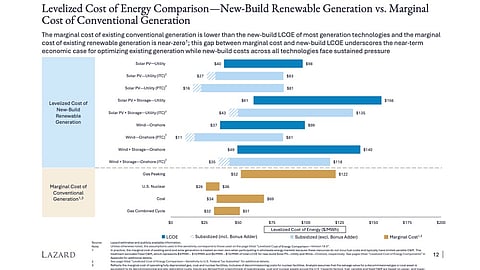
At the low end, the average LCOE of new-build unsubsidized utility-scale solar PV and onshore wind, as per the report, stands at $40/MWh and $37/MWh, respectively.
Co-located with storage, the LCOE of utility-scale solar PV rises to $61/MWh, and $49/MWh for onshore wind. In its previous iteration, Lazard pegged the LCOE of the hybrid projects at the low end at $50/MWh and $44/MWh, respectively (see Lazard Analysis: Utility-Scale Solar, Wind Still Cheapest Power Options).
In comparison, the average LCOE of gas combined-cycle plants at the low end is $51/MWh. For coal, it is $72/MWh; for gas peaking, $144/MWh; and for nuclear, $175/MWh.
Lazard said the LCOE for solar and wind has continued to increase due to higher capital costs, sustained interest rates, tariff pass-through and supply chain repricing. Despite these pressures, their costs remain below conventional new-build alternatives, analysts add.
Lazard said new combined-cycle gas turbine (CCGT) plants remain the lowest-cost dispatchable power option in markets with high electricity demand and low gas prices. However, capital costs and LCOE for these plants increased in the latest analysis.
Analysts also found that existing power plants are becoming relatively more competitive as higher new-build costs and project delays make replacement capacity harder to deliver. Rising electricity demand is also contributing to increased use of these assets. Yet gas and coal plants remain exposed to fuel price fluctuations.
Rising demand, grid infrastructure requirements, and permitting delays are adding further pressure to the power system. Lazard therefore called for faster permitting and approval processes, alongside greater investment in grid infrastructure.
Analysts also stress the need to maintain a diverse generation fleet to meet the growing demand for electricity.
“We’ve entered a speed-to-power era—demand is outpacing supply, costs are climbing across every technology, and value is shifting to whoever can deliver capacity the fastest,” said Samuel Scroggins, Managing Director and Head of Renewables & Sustainable Infrastructure at Lazard. “Renewables remain the lowest-cost and quickest to deploy resource, but meeting this moment will require a diverse generation fleet,” he added.
Lazard’s Levelized Cost of Storage Version 11.0 (LCOS 11) analysis shows higher costs for utility-scale standalone storage, reversing the declines recorded in the previous year.
At the low end, a utility-scale standalone 100 MW/2-hour storage system has an LCOS of $122/MWh, while it is $123/MWh for a 100 MW/4-hour system.
It attributes the increase partly to tariffs on lithium-ion battery imports, which have reduced access to lower-cost Chinese cells.
While the One Big Beautiful Bill Act (OBBBA) preserved the storage investment tax credit through 2033, Foreign Entity of Concern (FEOC) restrictions are accelerating battery supply chain diversification toward Southeast Asia and domestic US suppliers.
Despite higher costs, Lazard said battery energy storage remains an important resource for power systems integrating increasing levels of intermittent renewable generation.
The complete report is available for free download on Lazard’s website.
