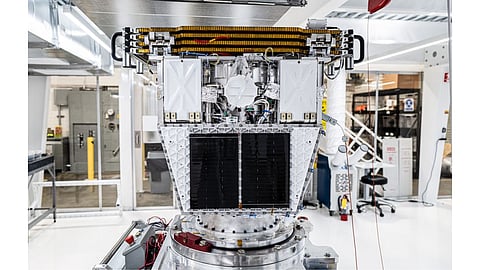


Reflect Orbital has raised $73.5 million in new funding, bringing its total funding to more than $100 million
The company is developing satellite-based mirrors to redirect sunlight toward solar farms on Earth after sunset
Its first orbital demonstration is planned for Q2 2027 to test the deployment and performance of its reflector technology
US-based space technology company Reflect Orbital has announced $73.5 million in new funding as it prepares to test its sunlight-reflection technology in space. The new funding brings Reflect Orbital’s total funding to more than $100 million. The company raised $20 million in May 2025 through a Series A round led by Lux Capital. Its latest round received continued support from Sequoia Capital, Lux Capital and Starship Ventures, with Buckley Ventures, Convective Capital, The Uncommon Group and Salesforce Ventures joining as new investors.
The company is working on a satellite-based system that would reflect sunlight onto selected areas on Earth. Solar farms are among the potential users of this technology, as reflected sunlight could help them generate electricity after sunset. The company also sees opportunities to provide lighting for rescue teams and construction workers operating at night.
The new funding will support the company’s first satellite launches and further development of its reflector technology. The first demonstration mission is expected in the second quarter of 2027 and has already received approval from the US Federal Communications Commission (FCC). During this mission, Reflect Orbital will study how its mirrors unfold and perform in low Earth orbit. It has also applied for separate FCC approval to test a developmental satellite and its communications systems.
The company has lined up additional launches for 2027, including two dedicated missions with India’s Skyroot Aerospace. These will use Skyroot’s Vikram-1 rocket and its Vikram-1U vehicle, which is still under development (see Reflect Orbital Books 2 Skyroot Rocket Launches).
Reflect Orbital also shared details of its satellite manufacturing activities. According to the company, its reflector quadrants are 28 times thinner than a human hair and can be folded into a package about the size of a shoebox. It currently produces one such quadrant every 3.5 days and completes a satellite roughly every 2 months.
Reflect Orbital Co-Founder and CEO Ben Nowack said the company is taking a science-led approach as it prepares for its first missions. He added that the planned tests will provide data on the deployment and performance of the reflectors in orbit, which the company will use to guide future development.