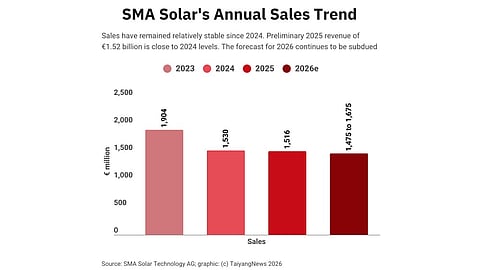


SMA Solar’s 2025 annual sales remained broadly stable at €1.52 billion, with inverter shipments rising to 19.9 GW
The Home & Business Solutions division continued to see weaker demand, with sales dropping and EBIT losses widening
Growth in the Large Scale & Project Solutions business helped offset some of the decline, though profitability was affected
SMA Solar Technology, the German solar inverter and battery storage manufacturer, exited 2025 with annual sales of €1.52 billion, reaching the higher end of its guidance, though the number was a slight decline from previous year’s €1.53 billion, according to its preliminary, non-audited financial results.
SMA’s total inverter sales during the year rose from 19.5 GW in 2024 to 19.9 GW in 2025.
It blamed lower sales and lower fixed cost degression due to persistently low demand and high competitive pressure for lower sales in its Home & Business Solutions (HBS) division at €247.2 million down from €354.1 million. EBIT for this division was in the negative, widening from -€315 million to -€375.6 million.
SMA had lowered its annual forecast for 2025 anticipating lower demand in the HBS division, expecting one-time charges of roughly €170 million to €220 million. According to its preliminary results, the company wrote down €40.2 million related to previously capitalized development projects and €30.3 million linked to machinery and production equipment, reflecting reduced expectations for future returns from these investments.
Large Scale & Project Solutions business, on the other hand, continued to drive the business increasing sales from €1.17 billion in 2024 to €1.3 billion last year thanks mainly to the expansion of its subsidiary Altenso GmbH with grid stabilization projects and large order backlog at the beginning of 2025. Its EBIT, however, dropped to €210.8 million (2024: €227 million). SMA lists increased warranty provisions and impairment on receivables in the US for this drop.
SMA’s EBITDA before one-time items reached €106.6 million; including one-time items its EBITDA was at -€65.4 million (2024: -€16 million). Net loss during the reporting year widened to €181.1 million, compared to the loss of €117.7 million.
“2025 was another extremely challenging fiscal year. The solar industry operated in a challenging environment characterized by highly volatile markets, geopolitical uncertainty and politically driven debates. This resulted in lower investment confidence in the US and Europe in particular,” said SMA CEO Jürgen Reinert.
At the end of 2025, SMA’s total order backlog reached €1.352 billion, almost the same level as last year’s €1.355 billion, comprising €1.02 billion in the product business (see SMA Solar Reports €93 Million EBIT Loss For FY2024 As Sales Decline).
SMA CEO Reinert said the company continues to execute on the internationalization of its development, production and services, for instance the software development operation at its Global Competence Center in India, and setting up additional final assembly capacity for HBS at its Kraków site.
In October 2025, the German group announced plans to reduce its global workforce by around 350, including 300 in Germany by 2026-end as part of its ongoing restructuring and transformation program that started in September 2024 (see SMA Solar To Reduce Workforce By Another 350 By 2026-End).
It expects these measures to bring in additional cost savings of approximately €100 million which will fully reflect in its earnings from 2027 and beyond.
“For 2026, we are expecting slight sales growth in the Large Scale & Project Solutions division and lower earnings than the previous year due to greater investment in the expansion of the service business, lower capitalization of development costs and foreign currency effects,” added SMA CFO Kaveh Rouhi. “We are anticipating sales growth and improved earnings for the HBS division. However, we will not yet reach the break-even point in the HBS division this fiscal year.”
For 2026, SMA expects to report between €1.475 billion and €1.675 billion annual sales and positive EBITDA of €50 million to €180 million. The guidance is however subject to change basis intensification of trade barriers or geopolitical conflicts, the management added.
