

A Schneider Electric study says total electricity system costs could fall by up to 40% in the 2030s as solar and battery costs decline
Mismatched battery deployment could push system costs up to 35% above the current benchmark
Growth in electricity demand from EVs, heat pumps and data centers will be important to maximizing savings from solar and battery deployment
Falling solar and battery costs could do more than make renewable electricity cheaper. Coordinating their deployment with growing electricity demand could reduce the overall cost of running electricity systems by up to 40% in the 2030s, according to new research by Schneider Electric.
The study, published by the Schneider Electric Research Institute (SERI), examined 40,500 scenarios to assess how the increasing adoption of distributed energy resources (DERs), particularly rooftop solar and battery storage, could affect electricity costs across the economy. For this analysis, it assumes surplus solar electricity is stored or curtailed rather than exported to the grid.
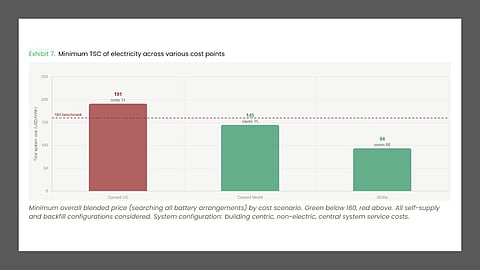
According to the analysts, total system costs under current average global cost conditions are already 10% below the existing benchmark. This could improve to 40% below current levels under the report's projected 2030s cost conditions.
However, the results vary by market. In the US, where installed solar and battery costs remain relatively high, total system costs are currently estimated to be 20% above the benchmark. The study considers both the cost of distributed energy resources and the expenses associated with centralized electricity generation and grid infrastructure.
It argues that while solar and batteries can reduce electricity drawn from the grid, they can also lower peak demand and free up existing grid capacity. However, the extent of these savings depends on how solar, batteries and new electricity demand develop together.
According to the report writers, battery deployment emerged as one of the most important factors influencing total system costs. The report found that selecting inappropriate battery capacities across residential, commercial and industrial assets could significantly increase costs. Under current average global cost conditions, a mismatch in battery arrangements could push total system costs as much as 35% above the existing benchmark.
Analysts stress that these findings highlight the importance of aligning battery capacity with the electricity consumption patterns of individual users.
The timing of deployment is equally important. If solar and battery installations expand without corresponding growth in electricity demand, the utilization of existing grid infrastructure could decline. This could increase the cost per unit of electricity as fixed grid and generation expenses are spread across fewer units of electricity sold.
To address this, the report recommends accelerating electrification alongside renewable energy deployment. Additional electricity demand could be generated through electric vehicles (EVs), heat pumps and data centers as these could utilize the capacity freed up through solar, batteries and flexible consumption.
The report also cautions that expanding electricity demand without sufficient distributed energy resources could create inefficiencies. It therefore identifies coordination between supply and demand as a central requirement for achieving lower system costs.
Schneider Electric identifies three priorities to support the transition:
First, electricity consumption patterns need to become more flexible. Time-of-use tariffs, demand charges and combined solar-and-battery incentives could encourage consumers to reduce peak demand and make better use of existing grid capacity.
Second, policies should support solar deployment and electrification together. Investment incentives and building codes that account for both could help prevent supply and demand from developing at different rates.
Third, reducing equipment costs will require affordable components, public procurement, streamlined permitting and workforce training to address shortages of skilled installers.
Laurent Bataille, Executive Vice President of Europe Operations at Schneider Electric, said that the electricity system would become cheaper only when solar, batteries and new demand developed in coordination.
“By scaling solar and batteries far quicker, Europe can get on a path towards energy sovereignty and competitiveness. The pieces are falling into place - what we need now is acceleration and coordination,” said Bataille.
The complete study titled System Costs of Electricity: A New Baseline for the 21st Century Economy, is available for free download on Schneider Electric’s website.