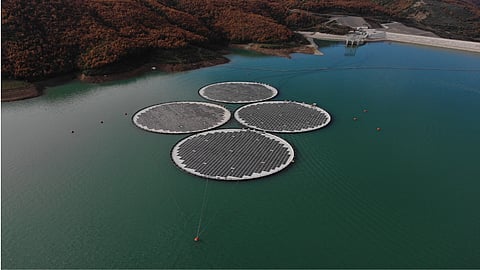


Tata Power and Norway’s Ocean Sun will undertake a 300 kWp floating solar pilot at Mulshi reservoir in Maharashtra
Ocean Sun’s design supports PV modules on a thin membrane floating directly on water, replacing conventional pontoon structures
The pilot will compare generation, installation, reliability, maintenance, and costs to assess suitability for wider deployment in India
Tata Power has partnered with Norway-based Ocean Sun to undertake a roughly 300 kWp floating solar pilot at its Mulshi reservoir in Maharashtra, India. The project will evaluate Ocean Sun’s membrane-based technology for performance, reliability, cost, and potential large-scale deployment under Indian conditions.
Conventional floating solar systems generally use linked pontoons to keep PV modules afloat. Ocean Sun mounts the modules on a thin, hydro-elastic membrane – a flexible sheet that floats directly on the water surface (see Membrane Based Solution For Floating PV Systems).
According to the companies, this lighter design could simplify transport and installation and reduce the amount of supporting structure needed. Placing the modules close to the water may also help cool them, potentially improving electricity generation. The pilot will assess these benefits in operation.
Tata Power will compare the system with conventional floating PV across electricity generation, capacity utilization factor (CUF), installation methods and time, reliability, and operation & maintenance (O&M) requirements. Capital costs and overall commercial viability will also form part of the assessment. The findings will help determine whether the technology is suitable for wider use in India.
Floating solar allows PV development on suitable water bodies, reducing land requirements. National Institute of Solar Energy (NISE) estimates that India has more than 102 GWp of floating solar potential.
The pilot project will provide operating data to assess whether the technology can supply electricity reliably and cost-effectively at a larger scale. The collaboration was announced on October 7, 2026, and the agreement was signed on the sidelines of the 2nd India-EFTA Prosperity Summit.
