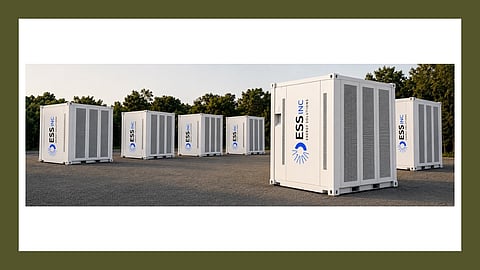


ESS Tech ceased operations and filed for Chapter 7 bankruptcy on November 13, 2026
It terminated all employees and officers as the company moved into liquidation
The decision followed its Q2 2026 financial results when its net loss widened to $15.6 million
ESS Tech, the US-based company that supplies non-lithium energy storage solutions, has filed for Chapter 7 insolvency proceedings in the United States Bankruptcy Court for the District of Delaware.
On November 13, 2026, the company ceased operations and filed a voluntary petition for relief under Chapter 7 after struggling with financial and liquidity challenges.
The company also terminated all employees and officers, including CEO Drew Buckley, CFO Kate Suhadolnik, and General Counsel and Chief Strategy Officer Kelly Goodman, effective November 13, 2026.
Under Chapter 7 proceedings, a court-appointed trustee will take control of the company's assets and liabilities and oversee their liquidation. ESS Tech said common shareholders are unlikely to receive any distribution from the proceedings.
The development follows a difficult Q2 2026, as ESS Tech reported revenue of just $73,000, compared with $2.36 million in the same period last year. Its net loss widened to $15.6 million from $11.1 million a year earlier.
For the first half of 2026, its revenue fell to $201,000 from $2.96 million in the corresponding period of 2025. The company reported a net loss of $31.5 million, compared with $29.1 million a year earlier.
Before filing for bankruptcy, ESS Tech had signaled a strategic shift toward sodium-ion battery solutions, citing growing demand from data centers and other power-sector customers. CEO Drew Buckley said the company was focusing on products with greater near-term revenue potential while continuing to develop its iron-flow technology for long-duration energy storage. The company also highlighted sodium-ion batteries as an option for customers seeking to avoid exposure to lithium-ion fire risks and Foreign Entity of Concern (FEOC) supply chains.
To expand its sodium-ion energy storage business, ESS Tech announced partnerships including with Juniper Energy for at least 500 MWh of storage deployments and an agreement with Alsym Energy to add 8.5 GWh of sodium-ion cells and modules to its portfolio.
At the time, the company said it had developed early-stage opportunities approaching $1 billion across data centers, critical infrastructure, and utility markets.
ESS planned to streamline its Wilsonville operations, cut operating expenses by 12% in H1 2026, reduce cash burn, and redirect capital toward sodium-ion products. It also reported growing interest in its sodium-ion technology and signed a non-binding letter of intent for a potential strategic business combination valued at approximately $515 million.
However, soon after, it filed for Chapter 7 bankruptcy, effectively ending these plans. The company stated that its assets will be liquidated and claims settled according to the priorities established under the US Bankruptcy Code.
In a Securities and Exchange filing, ESS Tech said it made the decision after considering all strategic alternatives.