

Wood Mackenzie’s new report on utility-scale BESS PCS shows Chinese-headquartered suppliers accounted for 62% of global shipments
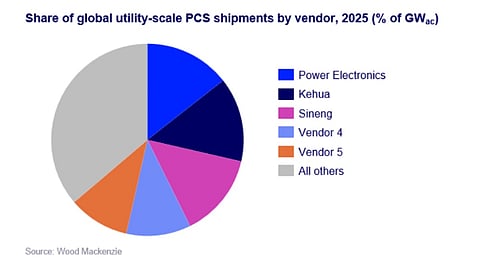
Power Electronics ranked first globally, ahead of Kehua and Sineng; the three companies together accounted for approximately 43% of shipments
Central PCS accounted for 75% of utility-scale shipments, while DC-coupled hybrid inverters represented 91% of distributed PCS shipments
Chinese-headquartered suppliers dominate not only the solar PV supply chain but also the utility-scale battery energy storage power conversion system (PCS) market, although their presence is more limited in North America. According to Wood Mackenzie, Chinese companies accounted for 62% of global utility-scale storage PCS shipments in 2025, compared with just 11% in the US and Canada.
Utility-scale projects accounted for 81% of total global PCS shipments in 2025, as per wood Mackenzie’s inaugural Global Energy Storage System PCS Market Share 2026 report launched recently. The report ranks PCS capacity embedded into the complete battery energy storage systems (BESS), not just standalone inverters.
Power Electronics of Spain led global shipments, marginally ahead of China’s Kehua and Sineng. Together, the trio accounted for close to 43% of the global utility-scale PCS shipments.
Central PCS systems accounted for approximately 75% of utility-scale shipments in 2025, partly because of their lower equipment cost per megawatt for large battery storage plants. The trio of Power Electronics, Kehua and Sineng mainly supply central systems. String PCS with integrated battery products were mainly supplied by Huawei.
Geographical distribution of the market shares varied though. Power Electronics dominated the US and Canada markets, delivering more than 10 GW AC to the US during the year. Tesla ranked second in the region, followed by GE Vernova.
In China, large domestic storage tenders supported Kehua and Sineng, helping both companies secure positions among the global top three suppliers.
Chinese-headquartered vendors captured 52% of utility-scale PCS shipments in Europe, where competition between Chinese and Western suppliers was more evenly balanced. Bankability and grid-code compliance remain important considerations in utility-scale project procurement, according to Wood Mackenzie’s Senior Analyst Timothy Shen who added that market access to Europe is determined by regional trade rules, procurement practices and technical requirements.
According to Shen, “Europe remains a highly competitive market, with Chinese and Western suppliers closely matched. Evolving cybersecurity requirements and advances in grid-forming technology could shift this balance in the coming years.”
Analysts expect string PCS systems to gradually gain market share, although central architecture is expected to remain dominant through 2027. In the distributed storage segment, covering residential and commercial storage inverters, Deye ranked first globally, followed by Huawei and Growatt. DC-coupled hybrid inverters accounted for 91% of distributed PCS shipments, reflecting the growing integration of solar PV and battery storage.
Suppliers with deep solar PV distribution channels have an advantage in the distributed storage market, highlighted Shen, adding, “As hybrid inverter adoption grows across residential and commercial segments, the line between solar and storage suppliers will continue to blur.”
Wood Mackenzie said cybersecurity requirements and advances in grid-forming technology could influence supplier competition and market rankings in the coming years.
TaiyangNews recently published the New Balance of System (BOS) Components 2026 report covering products from 74 companies. It reviews latest energy storage, inverters and power electronics products from leading solar shows in 2026. The report is available for free download here.