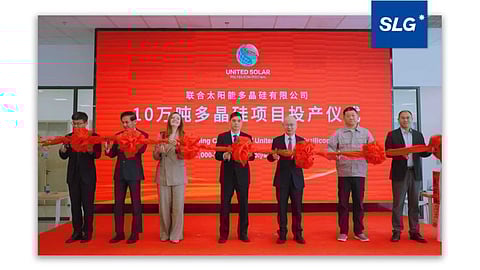


United Solar Holding has begun commercial operations at its 100,000 tpa polysilicon plant in Oman’s Sohar Freezone
Executed through its subsidiary USP, the factory will produce polysilicon equivalent to about 40 GW of solar module capacity when fully ramped up
The company has reportedly reserved land for potential downstream expansion, including 6.6 GW of wafers and 3 GW of cells in Oman
USP is also exploring integrated wafer, cell, and module manufacturing in the US with a public listing
United Solar Holding has commenced commercial operations at its polysilicon factory in Oman, with a capacity of 100,000 tonnes per day (TPA), equivalent to nearly 40 GW of solar module production capacity when fully ramped up.
The plant commenced operation at the Sohar Freezone, stated the project’s equipment supplier, Shuangliang Group (SLG), in a LinkedIn post. Executed through its subsidiary, United Solar Polysilicon (USP), the project raised over $900 million in financing from local and international lenders. A formal opening ceremony is expected in March 2026.
USP is reportedly securing green energy for the polysilicon factory as it develops a 700 MW solar power plant in cooperation with OQ Alternative Energy (see Middle East & Africa Solar PV News Snippets).
OPIS reports that the company, founded by former Daqo New Energy CEO Longgen Zhang, has also reserved a 400-acre land parcel at the factory site for the potential construction of a 6.6 GW wafer and 3 GW cell capacity.
With this full value chain deployed outside China, it will be fully traceable and compliant with the US Foreign Entity of Concern (FEOC) requirements, it adds, enabling companies using its polysilicon to access the US market. Waaree Solar Americas, the US arm of India’s Waaree Energies Limited, has invested in the company to source non-Chinese polysilicon for its US factory (see Waaree Solar Americas Invests In Polysilicon Producer).
Zhang, however, sees the US Section 232 investigation into polysilicon imports as driving up prices for non-Chinese polysilicon if tariffs are imposed (see Wood Mackenzie Calls Section 232 US Solar’s Biggest Challenge).
USP also plans to establish a 2 GW solar wafer and 2 GW cell capacity in the US, targeting an integrated manufacturing platform comprising 5 GW of wafers, cells, and modules. For this, it is exploring a possible US listing. Beyond the US, it remains open to countries with an interest in solar but no upstream manufacturing, like India. With its strategic positioning, USP could become a ‘direct competitor’ to Chinese polysilicon suppliers, added OPIS, while referring to Bernreuter Research’s Founder and Head, Johannes Bernreuter.
