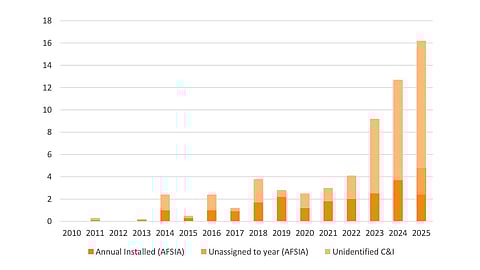


AFSIA estimates Africa’s total installed solar capacity at about 63.9 GW, based on Chinese export data, far above earlier industry estimates
Africa added significant solar capacity in recent years and emerged as the fastest-growing solar region globally in 2025, according to the analysis
Most of the previously 'unidentified' capacity is expected to be in the C&I and residential segments, highlighting a more mature and diversified market
Africa’s installed solar capacity may be far higher than earlier estimates, according to new analysis by the Africa Solar Industry Association (AFSIA). By cross-checking project-level data with trade statistics, AFSIA says the true scale of solar deployment on the continent has long been underestimated.
AFSIA’s new report, titled Africa Solar Outlook 2026, identifies 23.4 GW of operational solar projects across Africa at the end of 2025. These comprise annual additions of 2.5 GW in 2023, 3.7 GW in 2024, and 2.4 GW in 2025.
However, a top-down review of Chinese export data paints a much bigger picture, it adds. Using a bottom-up approach with information collected at the lowest possible level of detail, AFSIA says it identified over 42,000 projects totaling 296 GW, out of which 24.3 GW are in operation. This is a 26% increase in operational capacity compared to 2024.
Chinese export data, on the other hand, shows that manufacturers exported 58.1 GW of solar modules to African countries since 2017 alone, including 16.1 GW in 2025. When AFSIA extrapolates module exports prior to 2017, years for which official data are not available, the association estimates an additional 10% of capacity. This brings the likely total installed solar capacity in Africa to about 63.9 GW.
It expects the additional ‘unidentified’ solar capacity to be distributed across the commercial and industrial (C&I) and residential segments (85:15) since all other segments are officially documented extensively.
This would mean solar power is nearly 2.75 times more prevalent in Africa than most industry professionals previously believed, including AFSIA – before 2025. The findings suggest that Africa’s solar market is significantly more mature and extensive than commonly believed.
With Chinese export data, AFSIA says one can identify global and regional trends, enabling an apples-to-apples comparison with other regions. “And in 2025, this analysis identifies Africa as the globe’s fastest growing region for solar,” stress the analysts.
“These new figures illustrate that Africa, while still representing a minor fraction of the global solar business, is actually 3 to 4 times more important than the narrative may have conveyed over the years (from 0.7% to 2.6% of global capacity in 2023- 2025),” argues AFSIA.
“Over the past decade, Africa has repetitively been presented as one of the least attractive solar regions, representing a mere 0.5% to 1% of the market. But with the latest info collected, this perception is quickly changing,” said AFSIA CEO John van Zuylen. “But more importantly, Africa now appears to be experiencing one of the fastest growths on the globe and therefore becoming a key market to tap into for all types of industry stakeholders.”
The complete AFSIA report is available for free download on its website.
