

ClearVue Advances Rooftop Solar Panels with IEC Certification
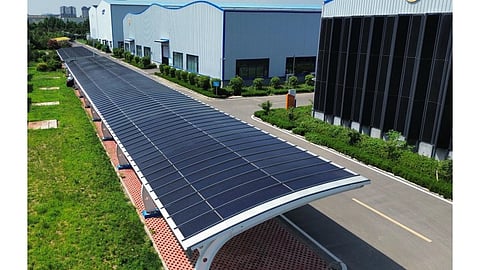
Smart building materials company ClearVue Technologies has received international certification for new metal-backed solar panels it has developed with manufacturing partner Helios Power Co. Ltd. The panels are designed for building-integrated photovoltaic (BIPV) rooftop and car park systems. The panels meet IEC 61730 (2023) and IEC 61215 (2021) standards, which confirm safety, durability, and performance for photovoltaic modules. ClearVue explains that the design uses metal backplates instead of traditional materials. This creates a weatherproof barrier that can extend roof life and reduce heat transfer. The panels also provide improved fire safety and stronger wind and typhoon resistance compared with standard rooftop PV panels.
There are 2 variants – with a steel backsheet (for easier maintenance) and an aluminum backsheet (for lightweight roofs). ClearVue said it will now begin the process of obtaining Clean Energy Council (CEC) certification for the Australian market as it works toward wider commercial deployment.
Vingroup Considers Replacing LNG Power Plant with Renewables
Vietnam’s Vingroup has reportedly asked the government to drop plans for the country’s largest LNG-fired power plant and instead develop a renewable energy project with battery storage. According to Reuters, Vingroup has cautioned the government that the planned 4.8 GW Haiphong LNG plant would require about 5 million tonnes of LNG annually, costing roughly $3.5 billion to $3.8 billion in annual imports. This will put pressure on Vietnam’s foreign exchange needs. Instead, the company suggested investing in a hybrid renewable energy project combined with a battery energy storage system (BESS), though the document Reuters cites notes that the cost would be significantly higher than the LNG plant, at around $25 billion. The LNG project’s first 1.6 GW phase had been scheduled for completion by 2030. The proposal follows an upsurge in LNG prices due to the conflict in Iran and disruptions to global LNG supply.
Perovskite Films for Rice Paddies in Japan
Sekisui Solar Film Co., TERRA Inc., Chiba University, Chiba Bank, and Himawari Green Energy have launched a joint industry–academia project to test film-type perovskite solar cells in agricultural applications. Recently, the partners installed an agrivoltaic solar facility at Chiba University’s Kashiwa-no-ha Campus. The 3-year project (starting from March 2026) will evaluate the performance of lens-type modules using perovskite solar films in paddy fields to assess impacts on rice cultivation, crop yield and quality, and GHG emissions such as methane.
The initiative aims to explore new solar deployment options in Japan, where limited flat land constrains conventional PV installations. Electricity generated from the system will be purchased by Chiba University under an on-site power supply agreement. The project builds on earlier field trials of perovskite modules in Sōsa City, Chiba Prefecture, which have been conducted since 2024.
On April 22, 2026, TaiyangNews will host a Virtual Conference on Next-Generation PV Technology where the focus will be on Perovskite Tandem Solar Technology Status & Outlook – Assessing Commercialization Roadmaps. Registrations are free and open here.
Inland Rail Upgrades Crossings with Standalone Solar Systems in Australia
Australia’s Inland Rail project has upgraded 2 level crossings that will now operate on fully solar-powered standalone power systems (SAPS) along the Narrabri to North Star (N2NS) Phase 1 section. Located north of Moree and Narrabri, the crossings are the first on the Inland Rail and ARTC network to shift from passive to active systems powered entirely by solar energy. Each crossing includes solar-powered high-intensity LED flashing lights, bells, and retro-reflective boom gates, with internal batteries providing overnight operation and emergency backup power. The systems also feature remote communications for monitoring and fault alerts.
By using solar power instead of grid connections, Inland Rail says it avoids new electrical infrastructure, reducing land access needs and environmental impacts. Inland Rail is also implementing solar-powered signaling systems at other locations once the project is online. Inland Rail is a 1,600 km fast freight rail line that will link Melbourne and Brisbane via regional Victoria, New South Wales (NSW), and Queensland.
Consortium Breaks Ground on 24 Microgrids in the Philippines
A consortium led by WEnergy Global, CleanGrid Partners, and Maharlika Clean Power Holdings has broken ground on a portfolio of 24 off-grid microgrids in the Philippines. The $35 million project, to be implemented through special purpose companies Archipelago Renewables Corporation and ARC II, will provide round-the-clock (RTC) electricity to about 11,560 households, benefiting more than 50,000 people across underserved communities in Palawan, Cebu, and Quezon. It was selected by the Philippines government under the Qualified Third Party Programme (QTP) and the new Microgrid Service Provider (MGSP) Act. Initially, the plan is to deploy 7 MW of solar PV and 8.0 MWh of BESS capacity, alongside 3.5 MW of diesel generation and a 225 km smart power distribution network across the 3 provinces.
The rollout marks the largest private-sector microgrid portfolio in the country, said the partners, and follows regulatory approvals from the Energy Regulatory Commission (ERC). The initiative builds on the consortium’s earlier Sabang microgrid project in Puerto Princesa, which has been operating since 2019.
Tokyu to Source 98 MW Solar Power via Corporate PPA
Japan-based Tokyu Corporation will procure electricity from about 98 MW DC of newly developed solar power plants across Japan under a 25-year corporate power purchase agreement (PPA) starting in fiscal year 2026. The projects, developed by special-purpose companies with investments from Tokyu and partners, will begin supplying power between April 2026 and the end of fiscal year 2027. The electricity will be used to power parts of several Tokyu railway lines, namely Toyoko, Meguro, Tokyu Shin-Yokohama, Den-en-toshi, Oimachi, Ikegami, and Kodomonokuni lines.
By FY2028, the initiative is expected to provide about 110 million kWh annually, covering roughly 30% of the electricity used to operate Tokyu’s rail network. Tokyu has been running all its railway lines on 100% renewable electricity since April 2022 through green power supplied by electricity retailers. It said the new agreement will increase the share of renewable energy directly linked to new generation capacity. In the future, both Tokyu Corporation and Tohoku Electric Power will support further solar development through off-site corporate PPAs and energy storage.
JV Targets Over 200 MW for C&I Segment in Vietnam
Asia-focused clean energy companies August Energy and Mega Energy have launched a joint venture (JV), August Mega Energy, to cater to the commercial and industrial (C&I) sector in Vietnam. The JV will target over 200 MW of deployed capacity over 3 years to be installed as on-site solar, utility-scale solar farms, and BESS. These installations will provide solar power to factories, industrial parks, and large commercial facilities in the country. With a focus on both greenfield and M&A of operating projects and portfolios, August Mega Energy will provide a full suite of services from origination to long-term operations.
IFC to Lend up to $125 Million to OCI TerraSus for Malaysian Fab
The World Bank Group’s International Finance Corporation (IFC) has announced a loan of up to $125 million for OCI TerraSus Sdn. Bhd. and Japanese silicon producer Tokuyama Corporation for their upcoming semiconductor-grade polysilicon manufacturing facility in Malaysia. It will produce essential raw materials for silicon wafers and semiconductor chips for the global semiconductor supply chain. OCI TerraSus, the Malaysian subsidiary of South Korea’s OCI Holdings Company, will power the fab in Bintulu, Sarawak, with renewable energy. OCI TerraSus is already operating an ultra-high-purity solar-grade polysilicon facility powered by hydropower at the Samalaju Industrial Park in Sarawak.
