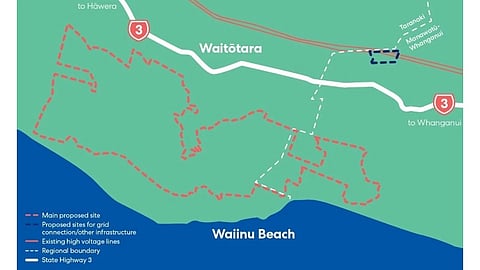


Meridian Energy, the New Zealand-based renewable energy company, said its proposed Waiinu Energy Park has been referred for consideration under New Zealand's fast-track consenting process. The project, planned northwest of Whanganui, will combine 392 MW wind, 230 MW solar, and battery storage. If approved, Waiinu would become one of New Zealand's largest renewable energy developments, with enough generation capacity to power up to 253,000 homes, generating close to 1,600 GWh of electricity annually. Meridian said it plans to submit its substantive consent application later this year.
Western Sydney International (WSI) Airport has partnered with CleanPeak Energy to supply 100% renewable electricity across the airport precinct as part of its sustainability strategy. The partnership includes managing the airport's existing 4.5 MW rooftop solar system, adding a 9 MW rooftop solar installation at the cargo precinct, and deploying a 120 MWh battery energy storage system (BESS) by late 2027. CleanPeak will also manage renewable electricity purchased from the grid and the airport's embedded energy network to support WSI's goal of achieving net zero scope 1 and 2 emissions.
On July 6, the Australian Energy Regulator (AER) activated the Retailer of Last Resort (RoLR) scheme for ZEN Energy after the company stopped supplying electricity, having entered voluntary administration. Under the RoLR, large customers will continue to receive electricity without interruption. They will be transferred to a new retailer, such as AGL, Origin Energy, EnergyAustralia, or ActewAGL, depending on their location.
On July 3, 2026, ZEN Energy entered voluntary administration after efforts to restructure and recapitalize the business failed. The company said that continued volatility in wholesale electricity markets affected the viability of its retail business despite support from stakeholders. It added that the sale of its renewable generation and battery storage infrastructure assets had been completed before the remaining business was placed into administration without naming the buyer. McGrathNicol has confirmed its role as the voluntary administrator of ZEN Energy.
Australian energy company AGL Energy has partnered with RRG Capital Management to develop a renewable microgrid for Koompartu Farms in South Australia's Riverland. The project is expected to be one of Australia's largest privately owned non-mining microgrids, said AGL. It will feature a 9.2 MW solar PV single-axis tracking system with more than 15,600 solar panels, a 10.2 MWh BESS, 16 diesel backup generators, and 19 km of underground high-voltage power lines. Built under a 20-year power purchase agreement (PPA), the project is expected to cut diesel generator use by 88% while improving energy reliability for the farm's irrigation operations, it added.
Swedish renewable energy developer OX2 has acquired the Corop Solar Farm and Battery Project in Victoria, expanding its renewable energy portfolio in Australia. Located near Rushworth and Stanhope, the late-stage hybrid project includes 230 MW AC of solar capacity and a 290 MW BESS with up to 4 hours of storage. OX2 says the project has secured key development approvals. It is currently at an advanced stage of the grid connection process, and has been awarded a contract under the Capacity Investment Scheme (CIS). Corop will become OX2's second owned and operated project in Australia, following the Muswellbrook Solar Farm and Battery Energy Storage System in New South Wales, which is currently under construction after reaching financial close earlier this year (see Asia Pacific Solar PV News Snippets).
Japan’s RENOVA said its consolidated subsidiary, Karumai West Solar G.K., resumed normal operations at the Karumai West Solar Power Plant on July 1, 2026, after completing repairs. The repair work was carried out for faulty power receiving and transformer equipment. The Japanese solar power plant had been offline since April 22, 2026. The company said the temporary shutdown reduced revenue, but the financial impact is expected to be minor as losses are covered by profit insurance and have already been included in its fiscal 2027 earnings forecast.
TotalEnergies ENEOS has commissioned a nearly 28 MW rooftop solar PV system at the Samsung Electronics HCMC CE Complex in Ho Chi Minh City, Vietnam. According to the company, the project is the first and largest rooftop solar PPA project under Vietnam's Decree 57 Direct Power Purchase Agreement (DPPA) framework using a private-wire arrangement. It said that the installation is expected to support Samsung's RE100 goals by increasing on-site renewable energy use, lowering electricity costs, and improving energy efficiency. It is projected to generate more than 40,000 MWh of electricity annually.
GameChange Energy, the US-based solar tracker manufacturer, has been selected to supply its Genius Tracker 1P Terrain Following system for the 380 MW Lower Wonga Solar Farm in Queensland. The project is being developed by Lightsource bp, with INTEC Energy Solutions serving as the EPC contractor. Previously GameChange Solar, GameChange Energy says the tracker system was chosen for its ability to adapt to challenging terrain, reduce earthworks and support efficient construction. The project will also use its HailStow and MaxGen technologies to improve system protection and energy generation.
Denmark-based renewable energy developer European Energy has reached financial close for a 130 MW solar PV and a 100 MW/220 MWh BESS in Australia. Financing for the Winton North Hybrid Renewable Energy Project was provided by Commerzbank AG, Singapore Branch, and Société Générale. Construction of the project is already underway and is expected to be completed in 2026. Amazon, which already holds a PPA for the solar output, has also signed a separate PPA for the BESS component.
