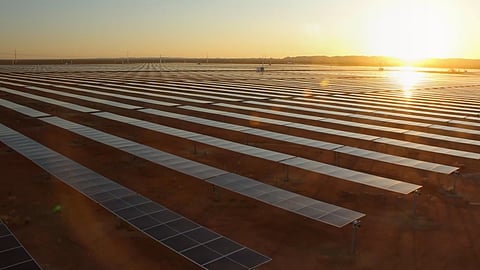


440 MW solar farm in Australia: Fortescue has started construction on a 440 MW Solomon Airport Solar Farm, calling it the largest solar development in Western Australia. Construction of this project in the Pilbara is scheduled to be completed in 2028. Once complete, it will deliver around 1/3rd of the total solar capacity required for Fortescue to achieve its Real Zero Target, it adds. This project, along with some other large-scale solar and wind energy facilities, will power the company’s operations across the Pilbara via Pilbara Energy Connect (PEC). Fortescue says PEC will have high-voltage transmission lines extending to over 620 km, which will physically link its energy assets to its operations and rail network.
ESS must in the Philippines: All upcoming renewable energy projects in the Philippines with an installed capacity of 10 MW or higher will now be required to add an energy storage system (ESS), according to a Department of Energy (DOE) directive. The ESS components needed to be integrated into such projects must have a capacity of at least 20% of the installed renewable energy plant capacity as part of the country’s Energy Storage Systems Policy. The DOE Department Circular DC2026-02-0008 is a supplemental and amendatory framework to strengthen the implementation of the ESS Policy, it stated. The DOE says the ESS systems must have grid-support capabilities, including but not limited to grid-forming (GFM) inverters to help stabilize voltage and frequency while mitigating the variability of renewables.
Dinawan project moves forward: The Investment Delivery Authority (IDA), on behalf of the New South Wales (NSW) government, has backed 16 projects in the maiden round of the former’s Expressions of Interest (EOI) endorsement. This initial tranche of projects includes the 2 GW Dinawan Energy Hub, comprising 1.2 GW AC of wind and 800 MW AC of solar farm capacity. This is being developed by Spark Renewables. Of the total 16 projects, 14 are energy projects valued at $34 billion, all of which will be supported by the IDA with accelerated approvals as part of its mandate to ensure expedited delivery of major private sector projects.
Solar for innovation hub: Hyundai Motor Group will invest nearly KRW 9 trillion to build an innovation hub in South Korea’s Saemangeum area of Gunsan city in Jeonbuk State. The center will host an AI data center with 50,000 graphics processing units. Of this, KRW 1.3 trillion is earmarked for solar power infrastructure to provide a sustainable energy supply for the innovation hub. It will also host a robotics manufacturing cluster, a polymer electrolyte membrane (PEM) electrolyzer plant, all of which will be powered by the solar power project. Both the AI data center and solar power infrastructure are scheduled to enter construction in 2027 and achieve completion by 2029.
Solar projects upgraded with storage in Japan: NTT Anode Energy, the Japanese energy company, has fitted its existing 2 MW AC/2.7 MW DC F Usuki and 1.32 MW AC/1.48 MW DC F Usuki II solar power plants in Japan’s Oita Prefecture’s Usuki city with battery energy storage systems (BESS). The storage capacity of 5.99 MWh and 4 MWh, respectively, comprises lithium-ion batteries; these are now online. It will store excess electricity and dispatch it when power demand is high, or market prices rise. With this, NTT says, it aims to improve renewable energy utilization and address grid congestion and supply-demand imbalances. NTT said the projects have now transitioned from the feed-in-tariff (FIT) to the feed-in premium (FIP) scheme.
RE for Australian chain: Woolworths Group, the Australia-headquartered retail chain, says it has become 100% renewable energy powered as of the end of 2025 across its operations in Australia and New Zealand. All of its supermarkets, distribution centers, BIG W stores, and support offices in these countries are powered by renewables comprising a mix of wind and solar. This includes more than 320 on-site solar power systems. “Since December last year, every single supermarket, BIG W store, distribution centre, and other Woolworths Group facility across Australia and New Zealand has been running on renewable electricity via from a mix of on-site solar and contracts or certificates to cover grid consumption,” said Simon Lowden, Woolworths Chief Group Public Affairs, Communication and Sustainability Officer.
Solar projects sold: Lightsource bp, the UK-headquartered global solar developer, recently offloaded 5 operational PV projects representing a combined 1.04 GW DC, in Australia to Aula Energy. This includes the Wellington, Wellington North, West Wyalong, Woolooga, and Wunghnu projects located in New South Wales, Queensland, and Victoria. Together, they are generating around 2,230 GWh of clean energy annually. “Our strategy in the Asia-Pacific region has evolved significantly since these projects were conceived and we are now focused on developing hybrid renewable projects that combine onshore solar and wind with battery storage to deliver firm, flexible, and low-cost energy,” said Lightsource bp’s Chief Operating Officer for Asia Pacific, Adam Pegg.
