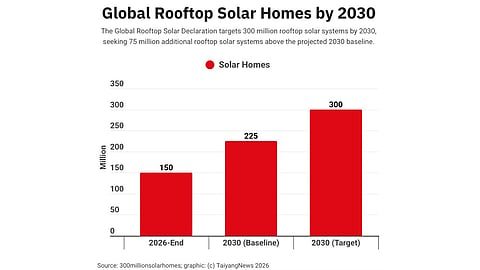


Australia is the first country to endorse the Global Rooftop Solar Declaration, which seeks to double solar-powered homes from around 150 million by the end of 2026
Reaching 300 million systems would represent approximately 2 TW of installed capacity and potentially benefit nearly 1 billion people, as per estimates
The initiative calls for national, state, and local leaders worldwide to endorse the Global Rooftop Solar Declaration ahead of COP31
Australia has become the first country to endorse the Global Rooftop Solar Declaration, a plan that aims to double the number of solar-powered homes worldwide to 300 million by 2030, from around 150 million expected by the end of 2026.
Speaking at the 2026 Pacific Pre-COP31 meeting in Fiji, Australian Minister for Climate Change and Energy and President of Negotiations for COP31, Chris Bowen launched the Global Rooftop Solar Pledge. Bowen said the pledge sends a signal to follow the science to keep the 1.5°C target within reach, “against the backdrop of the scientific evidence that we will overshoot it.”
An initiative of the Global Solar Council (GSC), backed by the Smart Energy Council Australia and Solar Citizens, among others, the declaration aims to double rooftop solar deployment within four years. The target underscores the scale of the ambition, given that it took the world about 70 years to reach the first 150 million solar homes.
Of the 150 million rooftop solar systems installed globally, around 115 million, or 80%, are residential systems, while the remaining 35 million, or 20%, are small commercial and community systems.
According to estimates, even without a major acceleration, the global market is likely to reach around 225 million rooftop solar systems by 2030. “The 300 Million Solar Homes goal is to help unlock a full 75 million rooftops beyond that baseline,” the partners behind the initiative said.
The declaration estimates that 300 million rooftop solar systems would represent approximately 2 TW of installed capacity worldwide with an average system size of 6 kW to 7 kW, benefiting nearly 1 billion people with cleaner, more affordable, and resilient electricity.
It counts building-mounted solar systems on homes, apartments, small businesses, schools, clinics and community infrastructure with a working size of around 0.3 kW to 100 kW DC for the initiative, not total distributed solar.
Australia is one of the leading rooftop solar PV markets globally. Bowen said 35% of Australian homes are fitted with rooftop solar systems, while the Smart Energy Council (SEC) pegs the volume at over 40%. In H1 2026, the country reported a 41% year-on-year (YoY) increase in rooftop solar capacity addition, along with a 52% increase in home batteries (see Australia Adds ‘Record’ Rooftop Solar, Batteries In H1 2026).
Australia backing the declaration is a ‘clear signal’ to other countries that the global community can tackle skyrocketing energy prices through rooftop solar and home batteries, the Global Solar Council says.
The partnership says reaching the 300 million target requires action in six areas. The steps include:
Making rooftop solar easier to access by cutting unnecessary red tape, ensuring faster approvals, clear permitting rules, transparent grid connection processes, fair metering arrangements, and trustworthy consumer information
Treating rooftop solar as core energy infrastructure by including it in national energy planning, grid planning, climate strategies, and energy affordability policies
Ensure access to affordable finance for families for rooftop solar and household electrification, including low-interest loans, credit guarantees, pay-as-you-save models, leasing models, and subsidies, among others
Modernizing grids to manage high levels of rooftop solar safely and reliably
Ensure fair transition by way of community solar, shared solar, solar on public buildings and local energy schemes to enable low-income households, renters, apartment residents, remote communities, and the rest to access rooftop solar benefits without owning a roof
Train and build a workforce, while expanding certification and safety standards.
Solar Citizens CEO Heidi Lee Douglas said rooftop and home solar is the ‘sleeping giant’ of global climate diplomacy, despite already powering millions of homes. She said the declaration provides a pathway to accelerate global deployment.
The partners are calling on national, state and local leaders worldwide to endorse the Global Rooftop Solar Declaration ahead of COP31 and help expand access to home solar. COP31, the 31st United National Climate Change Conference, is scheduled to be held from November 9 to 20, 2026 in Türkiye while pre-COP meetings are hosted in the Pacific Islands including Fiji and Tuvalu.
A recent report by the COP31 Presidency, the International Renewable Energy Agency (IRENA), and the Global Renewables Alliance estimates that an average of 1.2 TW of renewable energy capacity will need to be added annually between 2026 and 2030 to achieve the global target of 11.2 TW of installed renewable capacity (see IRENA: 1.2 TW A Year Needed To Meet 2030 Renewable Goal).
