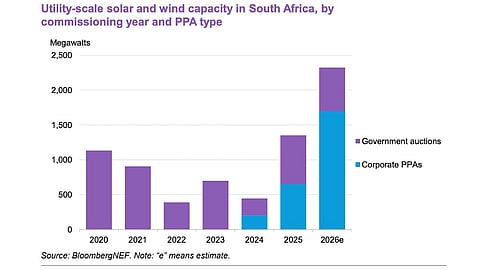


Corporate PPAs are becoming the main source of new utility-scale renewable capacity in South Africa, according to a new BNEF analysis
It says grid availability could determine how quickly planned clean-energy investment can move forward
While reduction in coal capacity is opening space for renewables, high power costs highlight competitiveness concerns
Bloomberg New Energy Finance (BNEF) projects South Africa to add 2.3 GW of new solar and wind energy capacity in 2026, with 73% of it supported by corporate buyers.
Analysts point out that, for the first time, corporate power purchase agreements (PPAs) are expected to drive more utility-scale renewable additions than government auctions.
The shift comes as South Africa moves beyond the ‘worst’ phase of its power crisis as persistent load shedding has ended after coal plants returned to service and private-sector participation increased.
South Africa’s power crisis has helped accelerate the adoption of clean energy, including solar and stationary storage. BNEF hails the government’s Battery Energy Storage Independent Power Producers Procurement Program (BESIPPPP) for making clean energy a key tool for grid stability, along with private sector solar projects (see Solar Wins South Africa’s REIPPPP 7 Renewable Energy Auction).
According to BNEF’s South Africa Transition Factbook 2026, private clean-power procurement is becoming a larger part of the country’s electricity market.
Since 2020, corporates in South Africa have signed up for 5 GW of clean power, including 3.1 GW from standalone projects and 1.9 GW from co-located projects. Standalone capacity comprises 1.5 GW of wind and 1.6 GW of solar, while co-located projects have become more popular in 2026, particularly solar-plus-storage.
Corporate buyers are also expected to remain the main driver of renewable additions through the end of the decade, BNEF said. Developers and buyers, however, continue to face challenges around project complexity and finding enough revenue streams to fully monetize batteries.
Under the PPA arrangement, solar energy remains cheaper than wind. In 2024-2025, solar PPAs in South Africa averaged ZAR 935/MWh, compared with ZAR 1,102/MWh for onshore wind. In 2026, BNEF expects solar PPA prices to fall to ZAR 848/MWh, while wind prices are forecast to rise slightly to ZAR 1,104/MWh.
However, the pace of investment could be limited by the availability of transmission capacity, even as investors, developers, and corporate energy buyers plan additional clean-power projects.
BNEF said faster grid expansion will be important if South Africa is to translate rising clean-energy investment into broader economic growth.
Nelson Nsitem, Africa Research Lead at BNEF, said the transition has reached a ‘critical inflection point’. “To date, private companies have played a central role in bringing new clean power into the system, but the next phase will depend on whether infrastructure can keep pace with investment,” added Nsitem.
Apart from grid constraints, electricity costs are another concern. BNEF said high industrial power prices are weighing on the competitiveness of sectors, including critical minerals and manufacturing, as South Africa is a major global supplier of strategic minerals. In 2025, the average industrial electricity prices in South Africa had reached ZAR 1,652/MWh, compared with ZAR 964/MWh in mainland China.
Under BNEF’s Economic Transition Scenario, solar, wind, and battery storage are expected to play a growing role in South Africa as the country’s aging coal fleet retires. Analysts project electricity demand to rise by 35% to 319 TWh by 2050, with solar and wind supplying 69% of that demand in the scenario, while coal’s share would likely fall to 21%.
Currently, however, coal dominates the country’s power system despite the growth of renewables. It accounted for 78% of South Africa’s electricity in 2025, down from 90% in 2015. Out of the country’s total 67 GW of installed power generation capacity in 2025, 43 GW was coal-based. Under the country’s 2025 Integrated Resource Plan, it targets retiring 8 GW of coal capacity by 2030 and adding 11.27 GW of new PV installations, expanding it to 25 GW by 2039 (see South Africa Targets 25 GW Solar PV By 2039 Under IRP 2025).
BNEF expects South Africa’s combined solar and wind capacity to more than double from 18 GW in 2025 to 38 GW by 2030, surpassing the 36 GW of coal planned under the country’s Integrated Resource Plan. Utility-scale solar is expected to rise from 7.8 GW to 14.8 GW, while small-scale solar grows from 6.2 GW to 13.4 GW. Wind capacity is forecast to increase from 4.4 GW to 10 GW, mainly driven by large energy users.
Last year, renewable energy investment in sub-Saharan Africa reached $14.6 billion, with South Africa as the largest market at $5.4 billion, followed by Nigeria at $2.4 billion, and Kenya at $1.4 billion. However, investments in South Africa fell 41% from $8.6 billion in 2024, as fewer utility-scale projects reached financial close, according to the analysis. Utility-scale solar investment dropped 57% to $1.4 billion, while onshore wind fell 30% to $2.1 billion. Small-scale solar was an exception, according to BNEF, as investment rose by 35% to $1.8 billion last year.
South Africa also remains heavily dependent on China for clean-energy equipment. BNEF says China supplied 98% of the country’s solar imports and 95% of battery imports in 2025.
Nevertheless, BNEF highlights a manufacturing opportunity for South Africa as interest in clean energy technologies accelerates in Sub-Saharan Africa.
“As sub-Saharan Africa becomes a larger market for Chinese clean-tech exports, South Africa has an opportunity to build domestic manufacturing and capture more of the region’s growing clean-energy supply chain,” states BNEF.
The factbook also points to opportunities in electric vehicles and clean-energy supply chains, but says infrastructure, electricity costs, and the country’s ability to capture more value from its mineral resources will influence how much economic benefit the transition generates.
The complete factbook is available for free download on BNEF’s website.
