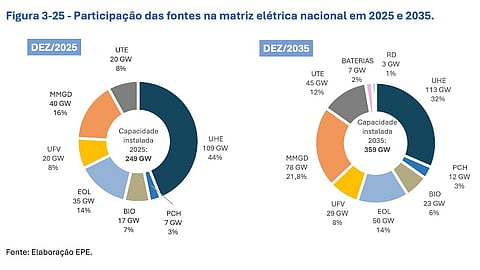


Brazil plans to expand cumulative installed solar PV capacity to 107 GW by December 2035, up from 60 GW in 2025
Under the draft Ten Year Energy Expansion Plan (PDE 2035), distributed solar grows from 40 GW to 78 GW, accounting for 22% of total installed capacity by the end of the period
Large-scale solar capacity is projected to increase from 20 GW to 29 GW, with the draft citing surplus renewable power on the grid and curtailment risks as limiting factors
Energy storage is expected to reach 7 GW by 2035, representing 2% of installed capacity in SIN, compared to zero capacity last year
Brazil aims to expand its cumulative installed solar PV capacity to 107 GW by December 2035, up from 60 GW in December 2025, comprising both utility-scale as well as micro and mini distributed generation (MMGD) systems, according to the country’s energy roadmap released by the Ministry of Mines and Energy (MME).
Under the country’s Ten Year Energy Expansion Plan (PDE 2035), solar capacity expansion will be led by the distributed generation segment, which will expand from 40 GW to 78 GW. It will account for 22% of the country’s installed capacity at the end of the projected period.
Utility-scale solar capacity is likely to grow more slowly in comparison, from 20 GW to 29 GW, for which the PDE 2035 draft cites surplus electricity from renewables on the grid. Given the resulting energy curtailments from this surplus, it does not make financial or operational sense to add more large-scale solar power plants.
Within these 10 years, Brazil plans to scale up its total power generation capacity from 249 GW to 359 GW, with solar’s 107 GW trailing hydropower’s 113 GW as the largest sources of electricity generation in the country.
On the other hand, storage has started to make operational and economic sense. The draft document sees storage representing 2% of the installed capacity of the National Interconnected System (SIN), with 7 GW capacity in 2035, up from zero last year.
The draft PDE 2035 is available on the ministry’s website for stakeholder consultation.
Alongside PDE 2035, which has a 10-year horizon and is indicative in nature, the ministry has also published the draft National Energy Plan 2055 (PNE 2055) that offers a 30-year horizon. The latter offers scenarios and explores technological trends and market dynamics while offering recommendations to guide policies and investments. Both are aligned with the National Energy Transition Policy (PNTE).
By 2055, Brazil presumes significant growth in the MMGD space, reaching up to 287 GW, while demand response (RD) could account for 23 GW capacity. Wind and solar will lead renewables and distributed energy resources (DER) to together account for 88% of the national electricity mix, including hydropower.
“The PDE (Energy Development Plan) and the PNE (National Energy Plan) structure decisions, guarantee predictability, and organize expansion based on technical data. It is on this basis that the National Energy Transition Policy is sustained, whose national plan represents the true roadmap for the country's energy transition,” said the Executive Secretary of the Ministry of Mines and Energy, Gustavo Ataíde.
Both these drafts are open for public consultation for 30 days from the date of publication (February 12, 2026).
