

Rajasthan could save up to INR 85 billion in 2030 by using solar, wind, and BESS instead of adding 3.2 GW of new coal capacity, says CEEW
It expects nearly 90% of the projected 5.5 BU power deficit during non-solar hours, highlighting the need for flexible generation and storage
The renewable-plus-storage pathway could lower system costs and attract about INR 600 billion in clean energy investment, it claims
Rajasthan could save as much as INR 85 billion in power procurement costs in 2030 by combining solar and wind with battery energy storage systems (BESS), according to a study by the Council on Energy, Environment and Water (CEEW). Analysts believe the approach could offer a cost-effective alternative to adding new coal capacity.
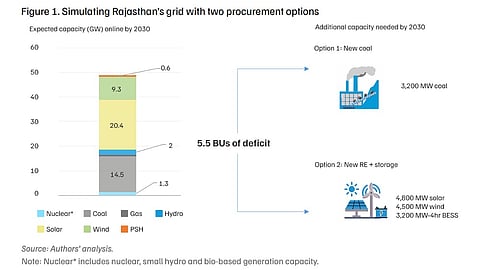
Titled How Should Indian States Choose New Power Generation Capacity? A Case Study of Rajasthan, the CEEW study examines a proposal made by Rajasthan distribution companies (discoms) in February 2025 to contract 3.2 GW of new coal capacity to address expected power shortages. This coal capacity addition will generate around 20 billion units (BU) of power annually and is intended to address a 5.5 BU power deficit.
“CEEW finds that Rajasthan’s 2030 shortfall is fundamentally a timing and flexibility problem, not just a capacity one. Nearly 90 per cent of the projected 5.5-billion-unit deficit occurs during non-solar hours, when solar generation is unavailable, and the system needs resources that can respond swiftly to demand,” reads the study.
Using a 15-minute production-cost simulation of Rajasthan's power system for 2030, the study compares three scenarios: business as usual (BAU) with all existing and planned capacities coming online by 2030; a pathway that adds 3.2 GW of new coal capacity; and an alternative pathway that meets the same reliability requirement with solar, wind, and BESS.
The renewable and storage option is designed to provide electricity comparable to the proposed coal capacity. It consists of 4.8 GW of solar, 4.5 GW of wind, and 3.2 GW of 4-hour BESS capacity.
Under the study's assumptions, the renewable-plus-storage pathway produces net savings of INR 11.4 billion to INR 85 billion in 2030 compared with the new-coal option. Rajasthan discoms could earn about INR 35 billion by selling surplus electricity through power exchanges, it adds.
CEEW says the third pathway is cost-effective across different assumptions for solar, wind, battery storage, and coal costs.
CEEW's modeling indicates that the additional 3.2 GW of coal capacity would be significantly underutilized. Its average plant load factor (PLF) is projected at about 34%, compared with typical design expectations of 70% to 80%. The study also finds that adding the proposed coal capacity would not fully resolve shortages during critical periods.
The CEEW study identifies a mismatch between Rajasthan's renewable generation and the timing of its electricity demand. In 2030, the state is expected to have around 5.5 BUs of electricity shortage, while also curtailing approximately 3.8 BUs of renewable generation. Solar is expected to account for about 86% of that curtailment.
CEEW says storage can help shift surplus renewable electricity generated during solar hours to periods when the system faces shortages. The analysis also points to increasing flexibility requirements. Analysts project net-load ramping needs to rise nearly fourfold between 2022 and 2030, with ramp rates exceeding ±150 MW per minute for about 5% of the time.
The study says coal generation alone would remain structurally inadequate to meet these requirements. CEEW estimates system costs of INR 3.84 to INR 4.09 per unit under the new renewable scenario, compared with INR 4.16 to INR 4.36 per unit under the new-coal scenario.
The renewable-plus-storage pathway is also expected to attract around INR 600 billion in clean energy investment and generate nearly 11 times as many full-time-equivalent jobs as the new-coal pathway by 2030. CEEW estimates that the renewable pathway would create about 27,000 FTE jobs, compared with 2,560 under the new-coal option.
It would also reduce Rajasthan's power-sector CO₂ emissions to about 52 million tonnes, around 24% below the new-coal pathway.
Disha Agarwal, a Fellow at CEEW, said discoms should assess procurement choices based on grid requirements and overall system costs, not technology-level costs alone. She added, “Our analysis shows that RE-plus-storage can meet Rajasthan’s future reliability needs at lower cost than the proposed coal capacity. SECI’s recent round-the-clock RE bid discovered a tariff lower than recently contracted or proposed new coal capacity in several states. Such studies establish the need for planning exercises that states must undertake continuously as technology capabilities and costs change rapidly and demand becomes more uncertain.”
CEEW calls for broader power planning, recommending that state discoms adopt scenario-based integrated resource planning on an ongoing basis. It also calls for procurement frameworks that allow mainstream generation technologies to compete on system-level costs. State regulators also need to strengthen their technical capacity to assess procurement proposals independently.
The study says Rajasthan's experience highlights the importance of assessing not only how much generation capacity is available, but also whether that capacity can supply electricity when it is needed.
The complete CEEW report is available for free download on its website.
