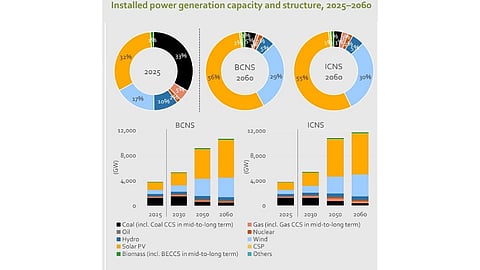


CETO 2026 report projects solar PV’s share of China’s installed power generation capacity is projected to rise from 32% in 2025 to 55%–56% by 2060
The combined share of wind and solar in electricity generation could exceed 74% by 2060
Grid expansion, storage and demand response will support higher renewable penetration
Solar PV is projected to become China’s largest source of installed power generation capacity by 2060, accounting for 55% to 56% of the total under the two scenarios outlined in the China Energy Transformation Outlook 2026 (CETO 2026).
CETO 2026 projects that solar PV’s share will increase from 32% in 2025 to 56% under the Baseline Carbon Neutrality Scenario (BCNS) and 55% under the Ideal Carbon Neutrality Scenario (ICNS) by 2060. Under the latter scenario, solar PV’s cumulative installed capacity could exceed 6 TW, comprising both utility-scale and distributed resources. Wind power’s share is projected to rise from 17% to 29% and 30% in the two scenarios, respectively.
By the end of 2025, China had 1.2 TW of installed solar PV capacity, with 1.8 TW combined with wind, reaching the halfway mark of its 3.6 TW target for 2035 (see China Sets New Annual Solar PV Installation Record In 2025).
Wind power and solar PV could jointly account for more than 74% of the country’s total electricity generation by 2060, while non-fossil energy sources are projected to contribute over 95% of the estimated 21,800 TWh to 23,600 TWh of total generation.
The China Energy Transformation Program launched the CETO 2026 executive summary at COP31, in which it makes these projections. The 4-year program (2021-2027) is jointly funded by the Children’s Investment Fund Foundation (CIFF) and the Danish government, and implemented by the Energy Research Institute (ERI) of the Chinese Academy of Macroeconomic Research.
The report outlines two scenarios for China’s energy transition under its vision of achieving carbon neutrality before 2060. According to the report, non-fossil energy sources, including wind, solar, hydropower and nuclear, are expected to provide around 50% of China’s electricity generation by 2030, becoming the mainstay of power supply. Their contribution could exceed 80% by 2045, with wind and solar PV accounting for 33%–40% of electricity generation by 2030, compared with 22% in 2025. Their combined share is expected to reach around 60% by 2045.
By 2060, the two sources could contribute more than 74% of electricity generation, while non-fossil energy sources collectively account for over 95%. The report projects China’s electricity share in the final energy demand to rise from 29.5% in 2025 to 62% to 67% in 2060.
As per the report’s projections, China’s oil demand will decline after 2026, with oil import dependence falling from 73% to 24% by 2060 under the baseline scenario and potentially reaching zero under the ideal scenario. Additional clean power generation will meet all growth in electricity demand by around 2030, with renewables alone covering the increase from 2035–2040.
The report identifies 2035–2040 as an important period in China’s transition towards renewable electricity when additional renewable power generation is projected to meet the growth in electricity demand. Wind and solar PV will likely become the primary drivers of electricity growth; however, their contribution is expected to vary across regions.
In northwestern China, their combined share could exceed 60% of local electricity generation by 2030. According to the report authors, this region will see the power system evolving most rapidly, and energy-transformation pressure will be the greatest.
To support this transition, China is expected to accelerate the development of large-scale renewable energy projects, aiming for cluster-based development, including in desert and Gobi areas of the Three North.
The report highlights the Ten-Year Action Plan for Doubling Non-fossil Energy, covering the 2026–2035 period. During the 15th Five-Year Plan period (2026–2030), the plan envisages more than 370 GW of installed capacity through integrated wind, solar PV, energy storage, and transmission projects across the desert and Gobi regions of northern China.
The plan also envisages around 100 GW of new offshore wind projects and more than 300 GW of additional distributed wind and solar PV capacity during the period. Distribution grids will be able to accommodate more than 900 GW of distributed new energy.
Vehicle-grid interaction will also reach 50 GW by 2030, and virtual power plants (VPPs) will exceed 50 GW. The country officially targets non-fossil fuel energy to account for 25% of the total energy consumption by 2030 (see China Solar PV News Snippets).
As variable wind and solar generation grows, analysts identify energy storage, grid expansion, demand response, and inter-regional electricity transmission as key measures to maintain supply stability.
By the end of 2025, China’s total installed energy storage capacity stood at 213.3 GW, dominated by new-type energy storage technologies (other than pumped hydro) with a 67.8% share at 144.7 GW.
It projects that China’s zero-carbon power regulation capacity will need to increase to more than 25 times its 2025 level by 2060.
Inter-provincial and inter-regional electricity transmission volumes are also expected to rise more than fourfold. Thermal power is expected to gradually shift from its traditional generation role towards providing system regulation, peak-load support, and emergency backup when renewable output is insufficient.
During the 16th Five-year Plan (2031-2035), the energy layout will be further developed and upgraded with integrated hydropower-wind-solar bases in key basins and long-duration energy storage, the report reads.
Nevertheless, the report stresses that achieving the country’s 2030 and 2060 targets will depend not only on technological innovation and widespread application, but also on greater international cooperation.
An executive summary of the report is available for free download on the China Energy Transformation Program’s website. The report will be published later.