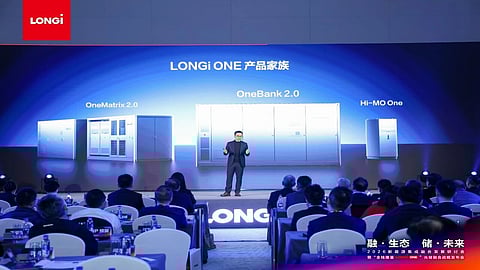


Leading PV manufacturer LONGi has unveiled its LONGi ONE integrated solar-plus-storage strategy, introducing a product portfolio covering utility-scale and commercial and industrial (C&I) applications and aiming to integrate PV and energy storage under a unified system and lifecycle management framework.
For utility-scale projects, the lineup includes the OneBank 2.0 and OneMatrix 2.0 storage series, while C&I users are offered the Hi-MO One solution paired with the EnergyOne cloud-edge-device smart platform. The strategy is designed to integrate modules, storage, and services under unified management and reduce compatibility issues between systems from different vendors.
LONGi also introduced its ‘2830 Plan’, targeting 30 localized service centers across major global markets by 2028.
Guizhou Province has launched its 2026 mechanism tariff bidding for incremental new energy projects, covering 15.3 billion kWh of mechanism electricity, including 10 billion kWh for wind power, and 5.3 billion kWh for solar PV.
The bidding ceiling is set at RMB 0.335/kWh for wind and RMB 0.345/kWh for PV, with floor prices of RMB 0.19/kWh and RMB 0.25/kWh, respectively. Selected projects will receive mechanism tariffs for 12 years. In the previous round, Guizhou awarded 2.387 billion kWh of wind and 2.641 billion kWh of PV mechanism electricity, with all projects clearing at RMB 0.3515/kWh.
China’s New Energy Consumption Monitoring and Early Warning Center reported a national PV utilization rate of 90.8% and a wind utilization rate of 91.5% in the first 2 months of 2026. The figure for solar is lower than the one reported for January 2026 (see China Solar PV News Snippets).
Regionally, Shanghai, Fujian, and Chongqing recorded 100% PV utilization, while Beijing reached 99.6%. Zhejiang, Jiangxi, Hunan, Sichuan, and Jiangsu all exceeded 97%, while the lowest utilization rates were recorded in Tibet at 60.8%, Qinghai at 78.7%, and Gansu at 82.5%.
The Shandong Provincial Energy Administration has released its 2026 action plan to improve renewable energy consumption through source-grid-load-storage coordination, targeting 14 GW of cumulative new-type energy storage capacity by 2026.
The plan also calls for around 10 GW of pumped hydro capacity in operation or under construction and more than 3 GW of flexibility retrofits for coal-fired power units. It supports integrated solar-plus-storage filing for new distributed PV projects and promotes clean energy-powered computing infrastructure, including compressed-air, electrochemical, and molten-salt storage projects under development in Tai’an, Weifang, and Zhanhua.
Solar module manufacturer Golden Solar New Energy Technology Holdings Limited reported FY2025 revenue of RMB 155 million, down 38.8% year on year (YoY). Its net loss for the period widened to RMB 308 million, with PV business revenue falling 73.3% to RMB 10.29 million.
The company attributed the decline to its transition toward flexible solar modules, high-efficiency hybrid back-contact (HBC) cells, and technology licensing. It said pilot-line HBC cell efficiency has stabilized above 27.5%, and partnerships with LONGi, JA Solar, Tongwei, and Golden Stone are expected to form around 20 GW of annual capacity in 2026, supporting future patent licensing and materials sales revenue.
Golden Solar recently signed a strategic cooperation agreement with Tongwei Solar and Gold Stone to advance HBC cell technology (see China Solar PV News Snippets).
