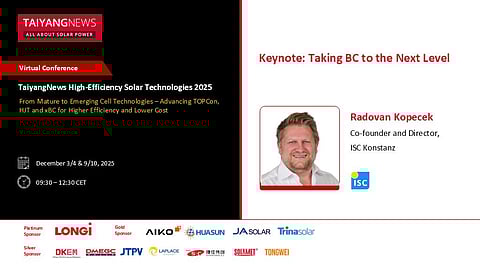


Radovan Kopecek, Co-founder and Director of ISC Konstanz, will be delivering the keynote address titled ‘Taking BC to the Next Level’ tomorrow, Day 1 of our annual flagship event, the TaiyangNews High-Efficiency Solar Technologies Conference.
This exclusive event brings together top industry experts to explore the latest breakthroughs driving high-efficiency solar cell and module technologies.
Across 4 days, leading voices will unpack cutting-edge PV trends – from Back Contact (xBC) and TOPCon to HJT, next-gen materials, breakthrough equipment, and smart system integration.
Each day focuses on one technology:
Day 1 – Dec 3, 2025: Back Contact (xBC)
Day 2 – Dec 4, 2025: TOPCon Solar Technology – I
Day 3 – Dec 9, 2025: TOPCon Solar Technology – II
Day 4 – Dec 10, 2025: Heterojunction Technology
Registrations are open and can be done for free here.
Ruijing Energy (Beihai) Co., Ltd., a subsidiary established by AIKO and Skyworth’s joint venture in Beihai, Guangxi Province, is advancing construction of its 5 GW high-efficiency BC module R&D and manufacturing base. According to the environmental impact assessment filed with local authorities, the project involves a total investment of RMB 2 billion and will comprise 2 production lines, each with an annual capacity of 2.5 GW. AIKO signed this investment agreement with Skyworth PV in April 2025 (see China Solar PV News Snippets).
The facility will adopt AIKO’s back-contact (BC) technology to produce 78-cell dual-glass modules (2,465 × 1,303 mm) with a rated output of 770 W. According to the filing, construction of buildings has been completed, and equipment installation and commissioning are about to begin.
Hebei Province has published the results of its latest mechanism tariff bidding for renewable energy. The bidding was carried out separately by the Hebei Southern Grid and the State Grid Jibei branch. The southern grid allocated 4.504 billion kWh of solar and 24.583 billion kWh of wind, while the Jibei grid allocated 13.856 billion kWh of solar and 21.935 billion kWh of wind. Individual projects could apply for up to 80% of their annual mechanism electricity volume.
According to the finalized tariffs, the Hebei Southern Grid set the mechanism tariff at RMB 0.3344/kWh for solar and RMB 0.353/kWh for wind, selecting 10,320 solar projects (1.4 TWh) and 104 wind projects (14.2 TWh).
For the Jibei grid, solar projects were awarded a mechanism tariff of RMB 0.352/kWh, with 1,172 projects selected (3.61 TWh), while wind projects cleared at RMB 0.347/kWh, totaling 37 projects (10.37 TWh).
Qinghai’s Development and Reform Commission has announced the province’s first batch of green power direct-supply pilot projects, under which renewable energy, such as wind, solar, and solar thermal power generation(CSP), is delivered to a single end-user via dedicated power lines with full physical traceability.
Qinghai selected 7 projects, covering applications including electrolytic aluminum, AI-computing integration, and oilfield operations. The combined installed capacity reaches 2,237.93 MW, comprising 1,750 MW of wind, 429.93 MW of solar PV, and 58 MW of CSP.
CNNP Optoelectronics, a perovskite manufacturer under China National Nuclear Corporation (CNNC), reports that its 200 MW fully automated mass-production line has achieved module-level efficiencies of 18.16% to 19.2% on 1.2 × 1.6 m² perovskite modules. The company commissioned this facility in May 2025 (see China Solar PV News Snippets).
TÜV SÜD tested 4 random sample modules from the same production day, which were found to deliver power outputs of 348.6 W to 368.6 W. Efficiency variation among modules was kept within 1%.
The company noted that the certified modules did not use modification layers or ALD-based surface treatments. CNNP Optoelectronics stated that the results validate the maturity of its large-area perovskite module manufacturing processes.
