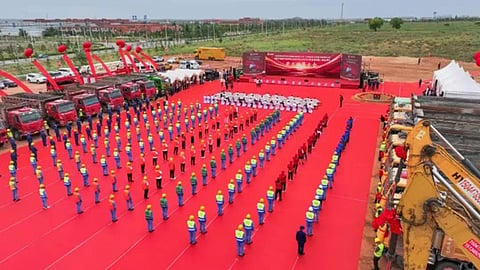


Coal and chemical producer Inner Mongolia Huineng Coal Power Group (Huineng Group) has started two coal gangue and fly ash resource utilization projects in Inner Mongolia, both integrated with source-grid-load-storage systems.
The Hangjin Banner project involves a total investment of RMB 69.6 billion. It will process 6 million tons of coal gangue and fly ash annually to produce 2 million tons of high-end aluminum-silicon and silicon-aluminum-titanium alloys. The project will include 7 GW of renewable energy capacity, comprising 6 GW of wind power and 1 GW of solar PV, to support an off-grid integrated energy system.
The Jungar Banner project has a planned investment of RMB 67.5 billion. It will also process 6 million tons of coal-based solid waste annually to produce 2 million tons of aluminum-silicon and silicon-aluminum-titanium alloys, with support from 8 GW of wind and solar capacity.
Lithium-ion battery manufacturer Sunwoda has announced that its subsidiary Sunwoda Mobility Energy (SEVB) will introduce Sungrow and a subsidiary of Tianqi Lithium as strategic investors through a Series C+ funding round.
The two companies will invest a combined RMB 805 million, subscribing to RMB 425.14 million in newly issued registered capital, representing a 2.93% stake in SEVB after completion of the transaction.
Sunwoda said the investment will strengthen collaboration across the supply chain. The partnership with Sungrow is expected to support the company's energy storage cell business, while cooperation with Tianqi Lithium is intended to strengthen lithium supply and reduce risks from raw material price fluctuations.
Sunwoda recently established a RMB 500 million investment fund through its wholly owned subsidiary Xin'neng Technology to support standalone energy storage projects in China (see China Solar PV News Snippets).
A 100 kW bamboo-based offshore PV platform, jointly developed by CIMC Raffles, China Forestry Group, and Beijing Forestry University, has been completed and launched. The platform, named Jilin No.2, will be installed at an offshore PV demonstration and testing base in Yantai, Shandong Province.
The platform uses third-generation bamboo-wound tubes as its main supporting structure, together with prestressed, continuous, fiber-reinforced, bamboo-based pipes developed by Beijing Forestry University. According to local authorities, the materials offer high strength, low weight, corrosion resistance, and renewability, providing an alternative to conventional steel structures and HDPE floats for offshore PV applications.
Anhui Province's Development and Reform Commission and Energy Administration have released draft implementation rules for the auction-based mechanism pricing of incremental renewable energy projects.
Under the draft, general and large-scale commercial and industrial (C&I) distributed solar projects commissioned on or after January 1, 2027, will no longer be eligible for mechanism pricing. Instead, project returns will rely primarily on self-consumption and surplus electricity trading.
The draft also proposes that wind and solar projects achieving full-capacity grid connection on or after June 1, 2025, will be eligible to participate in mechanism pricing auctions. Distributed wind and solar projects may participate independently or through qualified aggregators.
