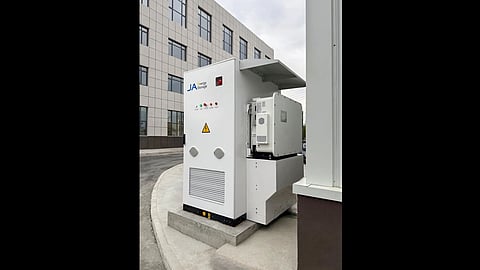


JA ESS has delivered the first unit of its JAPlanet Fusion hybrid commercial and industrial (C&I) battery energy storage system (BESS) to a solar project site.
Designed for weak-grid applications, including markets in Africa, JAPlanet Fusion adopts a DC-coupled architecture that integrates solar generation with battery storage. The system enables on-site solar consumption during the day, stores surplus electricity, and dynamically responds to changes in solar output, electricity demand, and grid conditions.
JA ESS said that Planet Fusion is scheduled to enter volume production in September 2026, supporting its expansion into weak-grid markets in Africa and other regions.
JA recently signed an ecosystem partnership memorandum with Medisheng Technology to develop solar-powered desalination solutions for coastal and island applications (see China Solar PV News Snippets).
Environmental services provider Datang Environment Industry Group has signed an agreement with Tianjin Jinghai Ziya Economic Development Zone to build a recycling and engineering demonstration project for decommissioned wind and solar equipment.
With a total investment of RMB 50 million, the project will include production lines capable of processing 10,000 tons of retired PV modules and 1,000 tons of wind turbine blades annually. The partners also plan to establish an integrated recycling chain covering collection, transportation, processing, and material recovery, alongside a joint innovation platform and intelligent control system to improve recycling efficiency.
Earlier this year, China announced a policy targeting a cumulative recycling and reuse volume of 250,000 tons of PV modules by 2027 (see China Solar PV News Snippets).
Solar wing manufacturer Aerosource Spacetech has supplied the solar arrays and spacecraft-rocket adapter for the 'Yinglong Fengguang-1' meteorological satellite, which has successfully completed orbital deployment.
The satellite is designed to provide high-precision meteorological data for renewable energy applications, improving the accuracy of solar and wind power forecasts and supporting more efficient power dispatch. Equipped with microwave temperature and humidity sounders and infrared cameras, it will deliver atmospheric profiling and surface temperature data to enhance generation forecasting models for PV and wind power systems.
The Peking University Ordos Research Institute of Energy has released the technical results of what it says is the world's first CO₂-based zero-carbon airport energy system.
The system has completed more than a year of operational verification at Ordos Ejin Horo International Airport, replacing gas-fired boilers and conventional refrigeration systems and increasing the airport's share of clean energy to over 90%. The project integrates PV, energy storage, cooling, heating, and power systems with cross-seasonal CO₂ energy storage and AI-based energy management.
The airport has also installed 80,000 m² of rooftop PV, expected to generate more than 10 million kWh annually, while a ground-source heat pump system has reduced air-conditioning energy consumption by 40%.
Unique Intelligent Starts Solar Tracker Component Facility
Solar tracker component manufacturer Unique Intelligent has started construction of a new manufacturing and R&D facility in Suzhou, Jiangsu Province.
The RMB 1 billion project will have an annual production capacity of 2.5 million bearing house assemblies (BHA), 6 million rails, and 10 million universal rack attachments (URA). The company said the facility will support growing demand for tracker components and strengthen its R&D capabilities for utility-scale solar projects.
