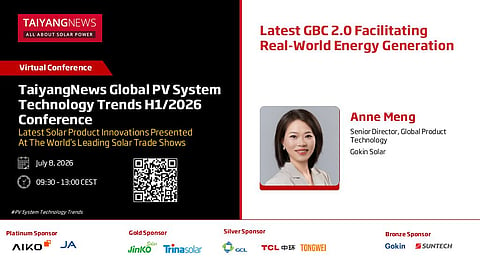


The TaiyangNews Virtual Conference on PV System Technology Trends – SNEC & Intersolar Product Review brings together technology experts, industry leaders, and market analysts to review and assess the most significant announcements and developments from The smarter E / Intersolar Europe and SNEC. The conference will highlight key technology trends and examine how the latest advancements are shaping the future of solar manufacturing and deployment.
Join us for the 2-day TaiyangNews virtual conference for an in-depth analysis of the technologies, trends, and strategic shifts emerging from the world's leading solar trade shows and discover what they mean for the next phase of growth in the global photovoltaic industry.
On July 8, Anne Meng, Senior Director, Global Product Technology at Gokin Solar, will be presenting on the topic ‘Latest GBC 2.0: Facilitating Real-World Energy Generation’.
Jie Zhu, Solution Manager at Suntech's ESS BU, will be presenting on ‘One-Stop Suntech Solar-Storage Solutions for Global Decarbonization’.
Participation is free and can be done here.
Major energy developer China Datang has released the shortlist of suppliers for its 2026-2027 framework procurement, covering 11 GW of PV modules and 9.5 GW of inverters.
A total of 15 companies were shortlisted for the module tender, including JinkoSolar, Tongwei, and Risen Energy, with bidding prices ranging from RMB 0.705/W to RMB 0.812/W.
Split into 3 packages, the procurement comprises 6 GW of n-type TOPCon modules at an average bid price of RMB 0.756/W, 1 GW of HJT modules at an average bid price of RMB 0.761/W, and 4 GW of BC modules at an average bid price of RMB 0.800/W.
For the 9.5 GW inverter tender, TBEA, Sineng Electric, and TEC were shortlisted. Bid prices for the 8 GW string inverter package ranged from RMB 0.099/W to RMB 0.104/W, while the 1.5 GW central inverter package received bids between RMB 0.161/W and RMB 0.180/W.
Microinverter and energy storage supplier Hoymiles announced that its HiOne residential energy storage system (ESS) has received TÜV Rheinland's highest 4-star usability certification under the new 2 PfG 3199/03.2026 technical specification.
The standard is among the first to evaluate residential energy storage systems based on installation, maintenance, and the full lifecycle user experience, assigning 60% weight to maintainability and 40% to installability.
The HiOne system supports configurations with 1 to 8 battery modules, providing storage capacities from 8 kWh to 64 kWh. It integrates the inverter, battery system, and energy management functions into a single platform and can reportedly be installed and commissioned within 15 minutes.
Its modular architecture supports hardware-level active bypass, seamless capacity expansion, and mixed deployment of new and existing battery modules throughout the product lifecycle.
Trinasolar, together with the University of New South Wales (UNSW) and research partners, has developed a silver-free tunnel oxide passivated back contact (TBC) solar cell concept to replace silver metallization with lower-cost aluminum.
Published in the paper Toward silver-free back contact silicon solar cells: Dual-polarity screen-printed aluminum contacts on poly-Si/SiOx passivated contacts, the research combines laser contact opening, non-fire-through aluminum paste, and optimized firing processes to achieve low contact resistivity and competitive contact recombination characteristics on both n-type and p-type poly-Si passivated contacts.
Device simulations based on the measured contact parameters achieved a simulated conversion efficiency of 25.89%, compared with 26.80% for a conventional silver-metallized TBC cell. It attributes the remaining efficiency gap primarily to higher recombination losses at the aluminum/poly-Si interface and increased series resistance. Future work will focus on paste optimization, interfacial engineering, and laser-assisted contact improvements.
On the topic of TBC, DAS Solar, together with Prof. Martin Green’s team at UNSW, published research outlining 2 industrialization pathways for TBC solar cells (see China Solar PV News Snippets).
China has completed its first inter-regional relay transmission of 100% renewable electricity combining solar PV and wind power, delivering green electricity from Qinghai and Heilongjiang provinces to Beijing.
The transaction leverages the natural 2-hour time difference between the 2 regions, routing excess midday solar generation from Qinghai and surplus nighttime wind generation from Heilongjiang via the Northwest-North China and Northeast-North China UHV transmission corridors to deliver more continuous renewable power to Beijing's AI and data center industries.
Completed in June, the transaction involved 63 generating companies in Qinghai and 27 in Heilongjiang, delivering 103 GWh and 131 GWh, respectively, for a total of 234 GWh of renewable electricity to 28 power users in Beijing. According to local media, the project demonstrates a new model for inter-regional green power delivery without relying on coal-fired balancing generation.
Perovskite manufacturer Mellow Energy has announced that its self-developed 30 cm × 30 cm ultralight flexible perovskite space solar module achieved a certified conversion efficiency of 21.79%, verified by TÜV Nord.
The module weighs just 0.5 g and delivers a power-to-weight ratio of 26 W/g, which the company said is among the highest reported for space PV modules.
Mellow Energy said the technology is designed for low-Earth orbit communication constellations and remote sensing satellites, where lightweight, foldable, high-efficiency, and mass-producible power sources are critical.
Earlier this year, Mellow Energy announced it had achieved 21.13% power conversion efficiency for its self-developed 30 × 30 cm² flexible perovskite solar module (see China Solar PV News Snippets).
