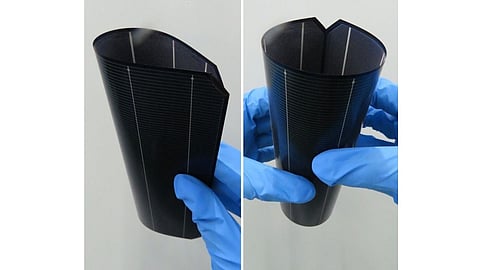


The National Natural Science Foundation of China (NSFC) has included the flexible perovskite-silicon tandem solar cell technology, jointly developed by LONGi Green Energy and Soochow University, in its ‘Top 10 Advances in China’s Science for 2025’ list.
To address interface delamination caused by repeated bending in flexible devices, the research team designed a double-buffer layer structure that improved device stability. The ultra-thin, flexible tandem cells, about 60 μm thick, achieved a laboratory efficiency of 33.4% certified by the US National Renewable Energy Laboratory (NREL), while full-size cell efficiency reached 29.8% with a power-to-weight ratio of 1.77 W/g.
By applying reactive plasma deposition of indium cerium oxide thin films, the team further raised certified efficiency to 33.6% and extended the continuous illumination lifespan to more than 2,000 hours. Other projects on the list include solar system exploration research and universal CAR-T cell therapy for autoimmune diseases.
Recently, another perovskite manufacturer, SunFlex New Energy, announced that its flexible perovskite solar cell production line in Zhuji, Zhejiang Province, has entered trial production (see China Solar PV News Snippets).
The Heilongjiang Provincial Government has released its 15th Five-Year Plan (2026-2030), aiming for new and renewable energy to account for 70% of total installed power capacity by 2030 and to push total renewable capacity beyond 80 GW.
The plan calls for large-scale wind and solar development while guiding the orderly expansion of distributed wind and PV projects, particularly on public institutions and commercial and industrial rooftops. It also includes plans to build pumped hydro storage and deploy independent energy storage stations.
As of the end of 2025, Heilongjiang’s cumulative renewable energy capacity had exceeded 33.24 GW.
China’s Ministry of Industry and Information Technology (MIIT) is seeking public comments on a draft mandatory national standard that sets safety requirements for terrestrial PV modules with system voltages up to 1,500 V.
The draft divides module insulation protection into Class II, Class 0, and Class III categories. Class II modules, intended for unrestricted access areas such as residential rooftops, require double or reinforced insulation, while Class 0 modules are limited to restricted-access areas with basic insulation, and Class III modules apply to low-voltage systems with Voc ≤ 35 V.
The standard also requires rigid framed modules on fixed mounting systems to withstand design loads of at least 2,400 Pa on the front and 1,600 Pa on the back, while other module types must withstand at least 1,600 Pa on both sides.
Earlier this month, MIIT and the National Energy Administration (NEA), along with 4 other government departments, issued guidance to promote the comprehensive utilization of retired PV modules (see China Solar PV News Snippets).
Shandong Province’s February 2026 electricity market report shows PV mechanism tariffs falling to RMB 50.941/MWh, down 64.8% month on month from RMB 144.825/MWh in January. Wind power settlement prices also declined by 16.6% to RMB 171.324/MWh.
Time-of-use data show that real-time electricity prices dropped to as low as RMB 18.941/MWh during midday hours, when solar generation peaked, significantly reducing the daily average PV price.
Following Shandong’s January 2026 policy requiring renewable energy to fully participate in the power market without fixed feed-in tariffs, the price drop indicates the growing revenue impact of solar’s midday generation profile.
