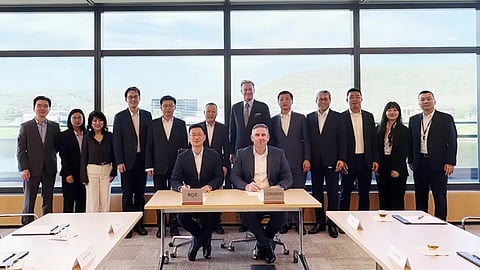


Display manufacturer BOE has signed a memorandum of understanding (MoU) with glass and materials company Corning Incorporated for collaboration on glass-based packaging substrates, foldable glass, perovskite glass substrates, and optical interconnect technologies.
The 3-year partnership combines BOE’s capabilities in display manufacturing and industrialization with Corning’s expertise in advanced glass and semiconductor materials to jointly develop new technologies and applications.
BOE also disclosed that it has invested nearly RMB 1 billion since 2024 to establish 3 perovskite R&D platforms, including a 25 mm × 25 mm glovebox platform, a 300 mm × 300 mm experimental line, and a 1,200 mm × 2,400 mm pilot line.
The company said the platforms will support parallel development of rigid, flexible, and tandem perovskite module technologies.
On the development side, BOE announced in December 2025 that it had achieved 4 perovskite records (see China Solar PV News Snippets).
PV module manufacturer GCL SI plans to convert a 7 GW TOPCon module production line in Funing County, Yancheng, Jiangsu Province, to back-contact (BC) technology.
According to an environmental impact assessment filing submitted to local authorities, the project will use existing facilities while adding equipment, including screen printers, string welders, and layout machines.
The company said total production capacity will remain unchanged following the technology upgrade.
GCL SI is the latest to announce such a transition, following Jolywood in October 2025 and LONGi in January 2026 (see China Solar PV News Snippets).
China added 41.189 GW of grid-connected solar PV capacity in Q1 2026, down 31% year-over-year (YoY), according to data from the National Energy Administration (NEA).
Utility-scale PV installations reached 19.619 GW, down 16.2%, while commercial & industrial distributed PV declined 61.5% to 12.04 GW. Residential rooftop PV was the only segment to record growth, increasing 88.7% YoY to 9.53 GW.
The shift followed electricity market reforms introduced in 2026 and the high installation base created by the 2025 ‘rush-to-install’ cycle. Increased pricing uncertainty weighed on utility-scale and C&I projects, while residential PV benefited from streamlined approval processes and relatively stable retail electricity prices.
China Introduces Multi-User Green Power Direct Supply Policy
China’s National Development and Reform Commission (NDRC) and National Energy Administration (NEA) have jointly issued a policy to support the development of multi-user green power direct supply projects.
The framework allows renewable energy projects, including wind and solar, to supply electricity directly to multiple industrial users via dedicated transmission lines with traceable green-electricity attributes.
Projects are classified into grid-connected and off-grid categories, with the policy encouraging integration of new renewable capacity with emerging industrial loads. Priority sectors include data centers, green hydrogen, green ammonia, and green methanol production.
The policy also supports aggregated participation of distributed PV projects and requires participating projects to follow a ‘load-to-source matching’ principle.
Under the rules, annual self-generation and self-consumption must account for at least 60% of available renewable generation and at least 35% of total electricity consumption before 2030.
