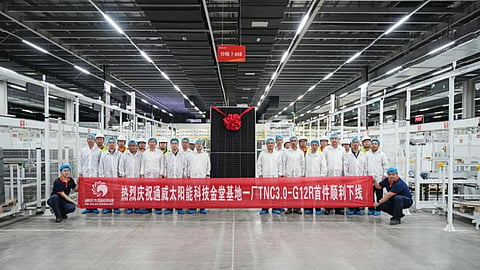


Leading PV manufacturer Tongwei Solar has begun mass production of its TNC 3.0-G12R high-efficiency modules at its manufacturing base in Jintang County, Chengdu, Sichuan Province.
The module adopts a 4-cut cell design intended to reduce operating current and optimize internal transmission paths, which the company said lowers internal thermal losses by 75%. The product features up to 90% bifaciality and a temperature coefficient of -0.26%/°C.
Tongwei said the TNC 3.0 series has already secured more than 1.5 GW of intended orders for utility-scale and commercial & industrial (C&I) applications across multiple countries, with production for initial deliveries already underway.
In March, Tongwei signed a strategic cooperation agreement with Gold Stone and Golden Solar (Quanzhou) New Energy to advance hybrid back-contact (HBC) cell technology (see China Solar PV News Snippets).
Heterojunction (HJT) manufacturer Leascend and satellite manufacturer ADA Space have established a joint venture, Leascend Guoxing Space Technology (Sichuan) Co., Ltd., with a planned investment of RMB 1 billion.
According to Sichuan Daily, the project will be developed in 3 phases and include a space energy headquarters, an R&D center, core component manufacturing facilities, and a space environment simulation testing platform.
The JV will focus on applying high-efficiency solar chips and space energy systems in spacecraft, including p-type HJT solar wings, satellite energy storage, and power systems. The companies said the first batch of jointly developed products has already completed in-orbit testing.
Late last month, Leascend Technology started mass production at its GW-scale HJT module facility in Meishan, Sichuan Province (see China Solar PV News Snippets).
Major energy developer China Datang has opened tenders for 11 GW of PV modules and 9.5 GW of inverters for the 2026-2027 period.
According to local media reports, the module tender includes 6 GW of TOPCon modules, 4 GW of back-contact (BC) modules, and 1 GW of HJT modules. The inverter procurement covers 8 GW of string inverters and 1.5 GW of central inverters.
PV backsheet and solar cell manufacturer Jolywood reported an adjusted net loss of RMB 1.449 billion for FY2025, widening nearly 58% year-on-year (YoY). Revenue declined 27.01% to RMB 4.449 billion.
Sales of major products also fell sharply, with backsheet shipments declining 47.24% to 71.9 million m², solar cell sales dropping 77.89% to 805.77 MW, and module sales decreasing 38.98% to 2.13 GW.
By the end of 2025, Jolywood’s annual designed production capacity stood at 17.5 GW for solar cells and 4 GW for modules.
The decline continued into Q1 2026, with revenue falling 69.63% YoY to RMB 495 million and adjusted net loss reaching RMB 268 million.
In March, Jolywood announced its plans to carry out a silver-reduction retrofit at its TOPCon solar cell plant in Shanxi province (see China Solar PV News Snippets).
Polysilicon producer Daqo Energy released its Q1 2026 financial results, reporting polysilicon sales of 4,500 tons for the quarter, down 84% YoY, despite production increasing 74.9% to 43,400 tons.
The company’s revenue declined 79.22% to RMB 189 million, while adjusted net loss reached RMB 813 million. The average polysilicon selling price increased nearly 30% to RMB 41.27/kg, while production cost rose 67.5% to RMB 88.91/kg.
Daqo attributed the weak sales performance to subdued downstream demand and prolonged pricing negotiations across the PV supply chain. The company also said idle production lines increased fixed-cost pressure and raised unit production costs.
For FY2026, Daqo expects polysilicon output to range from 140,000 tons to 170,000 tons, with Q2 production projected at 35,000-40,000 tons.
