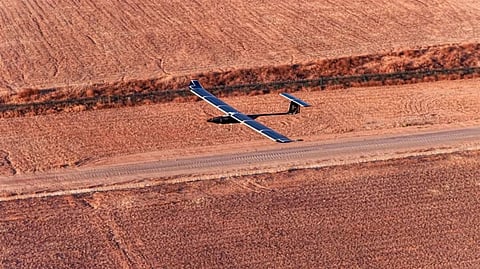


The China Academy of Aerospace Aerodynamics (CAAA) has completed the maiden flight of its independently developed ‘Qingqibing’ small and medium-sized pure solar-powered unmanned aerial vehicle (UAV) at an airport in northwest China. The institute describes it as China’s first commercial-grade UAV of its kind, following validation of its flight-control, avionics, energy-storage, and stability-control systems.
The UAV is 3.2 m long, has an 8 m wingspan, and weighs 45 kg at takeoff. It has a designed endurance of up to 30 hours, a service ceiling of 7,000 m, and a payload capacity of more than 5 kg. It can take off from a vehicle-mounted platform and requires about 20 minutes of ground preparation. Its communications and remote-sensing payloads are intended for applications including transport corridors, power transmission and pipeline inspection, water-conservancy infrastructure, ecological monitoring, and disaster surveillance.
CNNP Rich Energy, the clean energy development subsidiary of China National Nuclear Corporation (CNNC), has connected the first 700 MW of generating capacity to the grid at its 1.6 GW clean energy project in Jinta County, Jiuquan, Gansu province. The newly connected units have begun supplying electricity to the grid.
Construction began in March 2026, and the project comprises 900 MW of wind power and 700 MW of solar capacity, supported by two 330 kV step-up substations, one 330 kV step-down substation, a 440 MW steam and heat supply system, molten-salt thermal storage, and 250 km of transmission lines.
The project is part of the third batch of large-scale wind and solar bases in desertified areas under China’s 14th Five-Year Plan. It is also CNNC Group's first large-scale integrated demonstration project combining renewable power generation with industrial steam supply.
Energy storage manufacturer DoGo Power has put a grid-forming energy storage manufacturing facility into operation in Wenzhou, Zhejiang province. With an investment of more than RMB 100 million, it was initially planned to have a capacity of 2 GWh before being increased to 4 GWh in response to orders, according to local media reports.
In September, DoGo Power unveiled an intelligent grid-forming energy storage solution for medium- and large-scale commercial and industrial (C&I) applications and power plants. The company also disclosed that it had established three manufacturing centers, with a combined Phase I capacity of 10 GWh.
China Energy Engineering Corporation (Energy China/CEEC) has published the proposed awardees for its 2026 centralized PV module procurement tender, which has an estimated volume of 15 GW. Launched in September, the tender comprises six lots: two each for TOPCon, HJT, and BC modules, covering EPC projects and Energy China's self-invested projects.
Across the two TOPCon lots, 20 companies were named as proposed awardees, including TCL Zhonghuan (TCL TZE), JinkoSolar, and Trinasolar. Their implied unit bid prices ranged from RMB 0.695 to RMB 0.77/W.
Three companies were named for the HJT lots: Risen Energy, Dinto Solar, and LIANS Technology (previously Leascend), with implied unit bid prices of RMB 0.717-0.752/W. Six companies, including AIKO and LONGi, were named for the BC lots, with implied unit bid prices of RMB 0.76-0.779/W.
Liaoning Province has set the 2027 mechanism price for PV projects at RMB 0.20/kWh, down from RMB 0.30/kWh in the 2026 auction. The 2027 auction covers 1,028,633.547 MWh of electricity under the mechanism across 9,055 PV projects.
The 2027 mechanism price for wind power was set at RMB 0.30/kWh, covering 1,879,765.028 MWh across 30 projects, compared with RMB 0.33/kWh in the 2026 auction. The results show a steeper year-on-year decline in PV mechanism prices than in wind power prices.