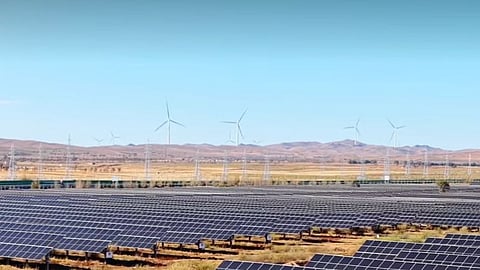


A 960 MW wind-solar-storage project in Ulanqab, Inner Mongolia, has been fully grid-connected. Developed by a subsidiary of China Huaneng, the project is designed to help retrofit a coal-fired power plant for more flexible operation. It combines wind, solar, battery storage, and static synchronous compensation. The company claims it to be the first project of its kind in China.
The facility comprises 810 MW of wind power, 150 MW of solar, a 60 MW/240 MWh grid-forming battery energy storage system (BESS) and a 20 Mvar static synchronous condenser (SSC), all supported by a 220 kV step-up substation. China Huaneng expects the project to generate approximately 2.3 billion kWh of electricity annually once fully operational.
Inner Mongolia’s energy regulator recently published an implementation list covering five PV desertification-control projects in Alxa League, with a combined capacity of 5.5 GW (see China Solar PV News Snippets).
Huawei Digital Power announced its FusionSolar Agent for solar-plus-storage has passed a security assessment by the China Academy of Information and Communications Technology (CAICT) and received certification under the Claw-type agent risk-management evaluation. According to Huawei, it is the first AI agent in China's solar-plus-storage sector to achieve this. The assessment followed the AIIA/T 0293-2026 standard and looked at deployment compliance, permission boundaries, operational monitoring, vulnerability response, security auditing, and resource release.
FusionSolar Agent uses an end-edge-cloud architecture to help plan, build, maintain, and run wind, solar, and energy storage plants, as well as coordinate dispatch. Huawei said the agent features a security guardrail gateway, multilayer isolation, least-privilege controls, prompt-injection detection, and emergency blocking to make core plant operations and maintenance safer.
Last month, Huawei Digital Power’s SUN2000-506KTL-H1 smart string inverter obtained certification under Germany’s VDE-AR-N 4110, 4120 and 4130 grid-connection standards (see China solar PV News Snippets).
Stellar Energy (Shanghai Xinghan Juneng Technology Co., Ltd.), a space solar technology company incubated by the Yangtze Institute for Solar Technology (YIST), provided p-PERC crystalline-silicon solar arrays for 6 of the 10 satellites launched on the improved Zhuque-2 Y4 rocket on October 14. Each satellite has over 3.2 m² of solar-wing area, for a total of more than 19.2 m² across the six satellites. YIST said this is China's first batch delivery into orbit of product-level, fully flexible crystalline-silicon solar-wing arrays.
The arrays will supply power to the satellites in low Earth orbit, where they will face high vacuum, large temperature swings, vacuum ultraviolet radiation, and electron irradiation. Unlike earlier crystalline-silicon demonstrations involving small-area payload tests or device-level validation, these products completed ground testing and customer acceptance before launching as complete solar-wing arrays on the constellation's first batch of satellites. The delivery covers the full product chain, from solar cells and interconnection packaging to complete solar-wing arrays.
China National Nuclear Corporation (CNNC) has announced the results of its 2026-2028 centralized framework procurement for lithium iron phosphate (LFP) energy storage systems. The chosen suppliers are Sungrow, CATL, ZTT Energy Storage, Zhuzhou CRRC Times Electric, and Kehua Digital Energy. Local media CNESA reported that bid prices ranged from RMB 0.4995/Wh to RMB 0.5329/Wh.
The framework procurement covers an estimated total capacity of 2.98 GWh, including 2-hour (0.5C) and 4-hour (0.25C) systems for co-located and shared energy storage projects. It does not specify air- or liquid-cooling technologies. Suppliers will be responsible for delivering and commissioning complete systems comprising batteries, power conversion systems (PCS), battery management systems (BMS), energy management systems (EMS), and transformers. The systems are based on a 1,500 V DC architecture and 35 kV grid connection, with capabilities including primary frequency regulation, automatic generation control (AGC), and reactive power support.
