

CSIRO and AEMO's latest GenCost report updates the cost outlook for electricity generation, storage, and hydrogen technologies in Australia
According to the report, solar PV and onshore wind are expected to dominate Australia's future electricity mix, supported by storage, hydro, and flexible generation
It projects further declines in battery costs while indicating higher costs for new gas-fired generation due to global turbine demand
Australia's latest GenCost 2025–26 Final Report reaffirms that renewable energy backed by storage remains the lowest-cost option for expanding the country's electricity system under a net-zero emissions pathway.
Australia's national science agency, Commonwealth Scientific and Industrial Research Organisation (CSIRO), and the Australian Energy Market Operator (AEMO) have released the GenCost 2025–26 Final Report. The report finds that declining battery costs are helping shield the country's electricity market from global energy shocks. At the same time, rising demand for gas turbines is driving up the cost of new fossil-fuel-based generation.
Now in its eighth year, GenCost is Australia's annual assessment of the costs of new-build electricity generation, storage, and hydrogen technologies. The latest edition incorporates updated technology cost projections, stakeholder feedback, and new modeling tools, including a System Levelized Cost of Electricity (SLCOE) methodology and an open-source electricity model to improve transparency in long-term energy planning.
The report projects that solar PV and onshore wind will supply around 93% of Australia's electricity by 2050 under a least-cost net-zero pathway. These will be supported by hydro, battery storage, transmission, and a limited contribution from flexible generation such as gas and hydrogen.
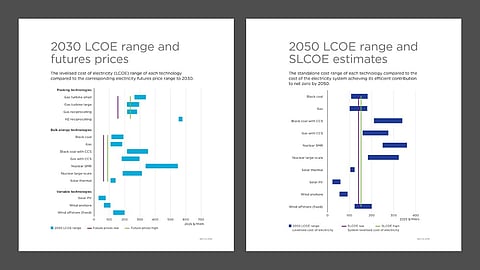
Analysts estimate wholesale generation costs for a net-zero electricity system at AUD 120-130/MWh by 2050, increasing to AUD 141-152/MWh when transmission costs are included.
Battery technologies continue to record significant cost reductions, with growing storage capacity beginning to compete with traditional gas peaking plants and contributing to lower evening electricity prices.
By contrast, costs for gas-fired generation continue to rise as strong global demand for gas turbines – driven largely by the rapid expansion of data centers in the US – has tightened manufacturing capacity.
The report also notes that costs for nuclear and new coal-fired generation have increased alongside higher turbine prices. The average generation price in Australia's National Electricity Market (NEM) fell to about AUD 104/MWh in 2025, down from AUD 189/MWh in 2022, when global gas prices surged.
“With 12 GW of coal retiring over the next five to seven years, we don't have time to continue debating nuclear, which would take decades to deliver. CSIRO's report again shows nuclear is not a realistic option and we urge policymakers to reach consensus on a renewable-led pathway forward,” stressed Clean Energy Council CEO, Jackie Trad.
Based on electricity futures markets, generation costs are expected to decline further to around AUD 80-90/MWh by 2030, although retail electricity prices will continue to depend on factors such as fuel markets, weather, network costs, and market competition.
CSIRO Chief Energy Economist and GenCost Project Leader Paul Graham said understanding how global events affect electricity technology costs has become increasingly important. “As battery costs continue to fall and gas technology costs rise, batteries are increasingly becoming the preferred flexible generation technology in the near term,” explained Graham.
He added that while batteries are taking on a larger role, gas-fired generation is still expected to provide around 3-7% of electricity generation by 2050 to help maintain system reliability.
Graham also said geopolitical developments and data center demand are currently the largest sources of uncertainty for future technology costs. “The impacts of the Iran war and data centre demand for gas turbines are currently the strongest drivers of uncertainty,” he added.
The report also finds that while some non-renewable technologies, including new black coal, may appear cost-competitive on generation costs alone, they would require more expensive emissions reductions elsewhere in the economy to achieve Australia's net-zero target.
It further concludes that no new electricity generation technology is expected to produce electricity for less than AUD 100/MWh by 2050, as aging generation assets are replaced.
The complete report is available for free download on CSIRO’s website.
