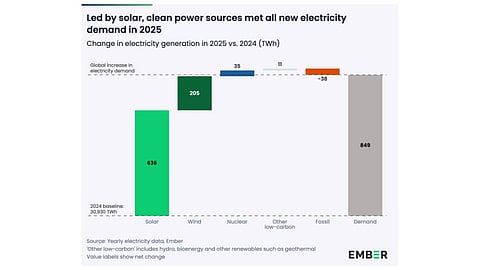


Solar added a record 647 GW and generated 636 TWh more electricity in 2025, accounting for about 75% of the increase in global power demand
Low-carbon sources fully met the rise in electricity demand, with solar and wind together covering 99% of the increase, according to Ember
Global fossil fuel generation remained flat and slightly declined, while renewables overtook coal in the global electricity mix for the 1st time
Solar power led global electricity growth in 2025, with record additions enabling clean energy to meet all new demand, keeping fossil fuel generation flat, according to a new Ember report.
Solar added a record 647 GW capacity in 2025, growing 11% year-on-year (YoY) from 582 GW in 2024. Global solar generation rose by 636 TWh, a 30% increase from the previous year, to reach 2,778 TWh. “This new solar generation would be sufficient to displace gas-fired electricity equivalent to all LNG exports through the Strait of Hormuz last year, estimated at 550 TWh,” according to Ember.
This marked solar’s fastest percentage growth in 8 years, despite significantly higher absolute additions, it notes.
Low-carbon power generation increased by 887 TWh last year, exceeding electricity demand growth of 849 TWh. Solar alone met 75% of the net increase in electricity demand. Solar and wind together met 99% of demand growth.
“For the first time since the Covid-19 pandemic in 2020, and only the fifth time this century, fossil generation did not rise, recording a small fall of 38 TWh (-0.2%),” reads the report.
Renewables (33.8% with 10,730 TWh) also overtook coal (33.0% with 10,476 TWh) for the 1st time in 2025 in the global electricity mix. Together, solar, wind, hydropower, and other renewables accounted for more than 1/3rd of global electricity generation for the 1st time in the modern power system, says Ember.
“This was the first year since 2020 without an increase in electricity generation from fossil fuels and only the fifth year without a rise this century,” claims the energy think tank.
According to Ember’s Global Electricity Review 2026 report, solar generation has increased more than 10-fold since 2015, roughly doubling every 3 years. It is now comparable in scale to the European Union’s (EU) total electricity demand.
China played a central role in this growth, accounting for more than half of the global increase in both solar capacity and generation in 2025 (see China Sets New Annual Solar PV Installation Record In 2025).
Fossil-fuel-based power generation declined in both China and India in 2025 – the first such drop this century. In China, it fell by 56 TWh as strong solar growth lifted clean energy above demand. In India, higher solar, wind, and hydro output, along with slower demand growth, cut fossil generation by 52 TWh after several years of increases.
The rapid growth of solar power is increasingly paired with battery storage, helping shift energy from daytime to round-the-clock use. Battery costs have fallen sharply for 2 years in a row – down 20% in 2024 and a further 45% in 2025 – while deployment rose 46% to about 250 GWh. This expansion allowed around 14% of new solar generation in 2025 to be stored and used at other times of the day.
Analysts stress that, as the Middle Crisis now once again exposes risks of fossil-fuel dependence, countries will have to shift their energy systems to be powered by clean energy.
“As geopolitical tensions threaten fossil fuel supply chains and trigger price volatility, the risks of fossil dependency have never been clearer. Clean power is becoming a fundamental pillar of national security,” stress the analysts.
The complete Ember report can be downloaded for free from its website.
Ember’s report echoes the findings of the recent IEA report, which says solar PV supplied the largest share of the global energy demand increase for the 1st time by growing its energy generation by a record 600 TWh in 2025 (see IEA: Solar PV Leads Global Energy Supply Growth For 1st Time).
