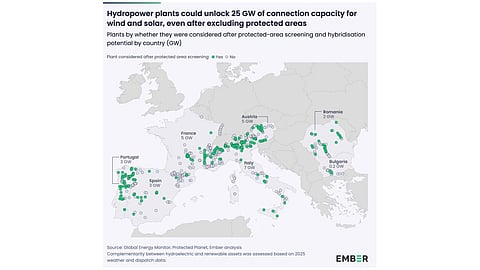


Ember says existing hydropower plants across seven EU countries could accommodate up to 25 GW of additional wind and solar capacity by making better use of current grid connections
Analysts argue that Europe's projected grid capacity shortfall by 2030 is creating an urgent need for solutions to accelerate renewable deployment
The report calls for dedicated regulations and faster permitting for hybrid renewable projects to accelerate adoption
The European Union (EU) has an opportunity to install over 25 GW of new wind and solar PV capacity by using existing grid connections being used by the bloc’s hydropower plants. This hybridization, explains global energy think tank Ember, could integrate 18% of upcoming renewable energy capacity without using additional grid capacity or requiring grid interventions.
Ember says hybridizing existing renewable assets – such as adding solar, wind or storage to existing grid-connected plants – can help make better use of current grid infrastructure without requiring new grid connections. This approach could support continued deployment of renewables, reduce infrastructure costs, and ease grid constraints.
All of this 25 GW wind and solar PV capacity, anticipated by 2030, can be added to the existing hydropower plants across seven EU nations, namely Austria, Bulgaria, France, Italy, Portugal, Romania, and Spain, says Ember in a new report.
However, limited grid capacity available in some countries such as Portugal and Romania, and zero capacity in Austria and Bulgaria, may make it challenging to add this capacity within 5 years. The report says Europe faces a grid capacity shortfall of more than 120 GW by 2030, which could slow renewable energy projects and electrification. While expanding the grid is essential, it will take time.
Collating scenarios from national grid operators, Ember says the seven identified nations expect to deploy approximately 138 GW of wind and solar between 2026 and 2030, representing more than a 50% increase over their existing combined wind and solar capacity of 235 GW in 2025.
Ember recommends that these countries add 25 GW of new wind and solar capacity behind the meter (BTM) of existing hydropower plants without disrupting their typical dispatch behavior. This could be a ‘crucial advantage’ in grid-locked countries, it adds. The seven identified countries account for 93 GW of the EU’s 131 GW hydropower capacity.
“For countries facing gridlock, hybridisation offers an immediate, zero-intervention solution. By stacking wind and solar behind existing grid connections, we can unlock the large-scale renewable deployment that underpins Europe’s security and competitiveness, while reducing the need for costly network expansions,” said Energy Infrastructure Lead, Ember Elisabeth Cremona.
Ember assessed the potential to add solar or wind to existing hydropower plants based on existing grid capacity and limiting hydropower curtailment to 5% annually. It excluded plants near protected environmental areas, and only sites meeting these criteria were included in the analysis. Germany was excluded because none of its pre-selected hydropower plants met the environmental screening requirements.
The analysis found that reservoir and pumped-storage hydropower plants use only 19% of their grid connection capacity on average. Hybridizing them with wind could increase utilization to 36%, while solar could raise it to 31%. Run-of-river plants currently use 29% of their grid connection capacity, which could increase to 47% with wind and 42% with solar.
According to the analysts, solar generation complements hydropower because solar produces electricity during the daytime, while many hydropower plants mainly generate during morning and evening peak demand periods. While wind can also be paired with hydropower, the complementarity is weaker, as wind generation generally aligns with seasonal electricity demand. Nonetheless, there is a growing interest in integrated wind-solar-hydro systems to maximize the use of a single grid connection, the authors point out.
Even though commercial deployments of such hybrid projects are advancing, regulatory support will be necessary to accelerate their rollout. According to the report, across the seven countries studied, only Portugal and Spain have regulations specifically supporting hybrid renewable projects. The others lack dedicated policies.
Ember says national rules and faster approvals for hybrid projects could help speed up renewable energy deployment and make better use of existing grid infrastructure.
The complete report, titled Power on tap: EU hydro giants can add 25 GW renewables without new grids, is available for free download on Ember’s website.
In an earlier report, Ember projected hybridizing solar with existing transmission lines of wind and hydropower plants in Türkiye to add 8 GW of capacity (see Ember: Turkey Can Unlock 8 GW Solar With Hybrid Plants).
