

NZIA could create a significant new market for resilient solar PV in Europe, but its rollout remains slow and fragmented, says SolarPower Europe
Only six EU countries have so far begun implementing the new resilience rules
It calls out the ‘patchwork’ approach taken by member states, while calling for consistent implementation
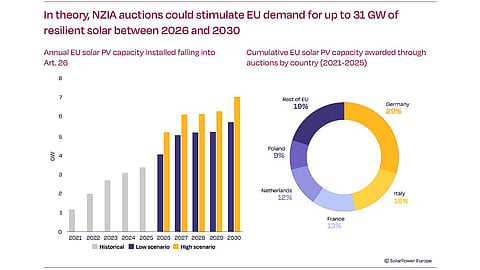
Renewable energy auctions under the European Union’s (EU) Net-Zero Industry Act (NZIA) could drive demand for up to 31 GW of ‘resilient’ solar PV between 2026 and 2030, according to a new study by SolarPower Europe. However, implementation of the act’s resilience requirements remains slow and varies across member states.
Adopted in June 2024, the NZIA aims to build 30 GW of annual solar PV manufacturing capacity across the EU value chain by 2030. Under Article 26 of the NZIA, member states are required to apply non-price criteria to at least 30% of annual renewable energy auction volumes, or a minimum of 6 GW per year, from 2026. These criteria include supply-chain resilience, sustainability, cybersecurity, responsible business conduct, and the ability to deliver projects on time (see EU Rolls Out NZIA Rules for Sustainability in Auctions).
In its study titled Industrial Policy for Solar PV: National Implementation and Progress Report, SolarPower Europe estimates that NZIA-compliant auctions could result in 4 GW to 5 GW of annual solar installations in 2026, increasing to around 6 GW to 8 GW by 2030.
Over the full 2026-2030 period, this could translate into up to 31 GW of auction-driven solar capacity under the framework of Article 26 of the NZIA, according to the analysts. Additionally, they identify a potential 8 GW ‘addressable’ market for resilient solar through public procurement over the same period under Article 25. Germany, Italy, and France are expected to account for nearly half of this volume, reflecting the size of their rooftop PV markets.
Under Article 28 of the NZIA, which supports solar PV through measures such as subsidies, tax incentives, and other financial support, analysts estimate around 70 GW of ‘addressable’ PV capacity, based on a country-specific assessment of existing support schemes and expected policy changes. Annually, this could translate into 13 GW to 16 GW of capacity. This represents about 45% of the total rooftop PV capacity expected to be installed by 2030.
Despite the potential, SolarPower Europe finds that EU countries are at different stages of implementing the NZIA, with only six countries having started the implementation.
Among these, Italy has already tested resilience requirements at scale through its FER-X auction. The resilience segment awarded 1.1 GW of solar at an average strike price of €66.4/MWh, compared with €56.8/MWh for 7.7 GW awarded through the parallel technology-neutral auction. This represents a price difference of around 17%, according to the study (see Italy Awards 1.1 GW Solar PV Under 2nd FER-X Auction).
The country has set a 10 GW quota for solar PV for its upcoming FER-X auction (see Italy To Support 10 GW Solar PV Capacity Under New FER X Scheme).
France has introduced resilience requirements in its ground-mounted PV auctions. At least four of eight key components, including modules, cells, and inverters, must not be assembled in a dominant non-EU country, and systems must not be assembled in that country. The country has also introduced supply-chain documentation and verification requirements covering manufacturing origins and production sites.
While Ireland has allocated 5% of its non-price auction scoring to resilience criteria, Austria has introduced a 20% ‘Made in Europe’ bonus for eligible PV and battery storage projects (see Austria To Offer ‘Made In Europe’ Bonus For Solar & Storage).
Lithuania is offering higher subsidies for private households to go solar under Article 28 of the NZIA. Spain has also adopted resilience-related approaches through public support schemes, according to the study.
Despite the emerging national measures, SolarPower Europe says member states are progressing slowly and using ‘diverging approaches’ to implement the NZIA.
“We see development in the right direction, but implementation is too slow. That itself is a concern, but more serious is the patchwork approach taken by Member States,” observes Anett Ludwig, Head of Supply Chains, SolarPower Europe.
The association argues that a more consistent and balanced implementation will be needed for the policy to effectively support Europe's solar manufacturing base across the EU Single Market.
The upcoming Industrial Accelerator Act (IAA) would strengthen the NZIA by adding a ‘Made in EU’ criterion. It will make it mandatory for solar projects receiving public support to use EU-manufactured PV inverters and solar cells within three years of the law being enacted (see Draft Industrial Accelerator Act: Prioritize Made-In-EU Solar Inverters & Cells).
“To create a prosperous future for European solar manufacturing these demand-side measures alone are not enough. We need financing support, too; a Cleantech Manufacturing Bank under the European Competitiveness Fund, with production-linked financial support. This is essential for any credible industrial policy,” added SolarPower Europe Deputy CEO Dries Acke. The association, along with the larger EU solar industry, wants the EU to introduce urgent production-linked support beyond the NZIA framework (see EU Solar Industry Calls For Immediate Manufacturing Support).
The complete report is available for free download on SolarPower Europe’s website.
The SolarPower Europe report follows an audit of the REPowerEU by the European Court of Auditors (ECA), which sees the EU’s plan for energy independence from Russia as ‘faltering’ (see EU’s €300 Billion REPowerEU Plan ‘Faltering’, Auditors Find).
