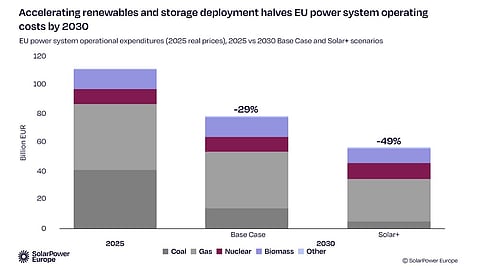


A new SolarPower Europe report says the Solar+ pathway could cut annual electricity system costs by €55 billion, nearly half compared to 2025 levels
Faster solar, storage, and electrification in the EU could reduce reliance on gas and lower wholesale power prices and volatility
In this scenario, the EU’s battery storage fleet expands to 171 GW/598 GWh by 2030, strengthening flexibility, but it will still be below long-term needs
Europe could reduce its annual electricity system operating costs by €55 billion, or 49% compared to 2025 levels, by 2030 under a more ambitious solar and storage deployment pathway, according to a new report by SolarPower Europe (SPE).
The findings come from the report Solar+: An EU pathway to achieve renewable targets, price affordability, and energy security, which compares a business-as-usual (BAU) scenario with a higher ambition ‘Solar+’ scenario aligned with the EU’s 2030 energy and climate goals.
Under current deployment trends, SPE projects that operating costs will fall by €33 billion. However, the Solar+ scenario delivers an additional €20 billion in savings, highlighting the economic benefits of accelerating solar, electrification, and energy storage.
The analysis, modeled by SPE’s prime market research partner Rystad Energy, also shows that increased renewable capacity would influence electricity prices. In the Solar+ scenario, variable renewables set power prices in 19% of hours, compared to 14% in the base case, reducing dependence on gas and other thermal generation to determine market prices.
“The analysis points out that when wind and solar – referred to as variable renewable energy sources (Variable RES) – set the electricity price more often, the prices are clearly lower,” reads the report. “Furthermore, flexibility reduces the downsides of variability.”
The report highlights the role of flexibility in managing renewable variability. Increased flexibility – such as storage and demand response – can reduce sharp swings in daily electricity prices, where surplus renewable generation leads to very low prices that later spike during peak demand.
According to the analysis, the Solar+ scenario strikes a balance between affordability and investment stability. Negative price hours remain below 500 hours per year through 2030, helping safeguard returns for renewable developers. At the same time, wholesale day-ahead electricity prices fall by more than 10%, providing cost benefits to consumers.
Battery storage scales fast in both scenarios. The EU’s total operating battery storage capacity reaches 116 GW/267 GWh by 2030 in the base case scenario, and 171 GW/598 GWh in the Solar+ scenario with longer average duration of 2.3 hours and 3.5 hours, respectively, vis-à-vis 1.9 hours in 2025.
“Reaching 171 GW and close to 600 GWh in our Solar+ scenario shows real progress towards deeper system flexibility. However, even this higher‑ambition scenario still falls short of the storage volumes Europe ultimately needs, underlining the urgency for stronger policy action to unlock flexibility at scale,” said SolarPower Europe’s Head of Battery Storage Europe Platform, Sonja Risteska. “Only by closing this gap can renewables fully deliver energy security, stability and affordable electricity for consumers.”
The report finds that accelerating solar PV to 600 GW and expanding battery storage capacity 8-fold to 600 GWh could raise the EU’s renewables share to 68%, broadly in line with European Commission benchmarks. As renewables increasingly set electricity prices and displace gas-fired generation, system operating costs could be cut by half compared to 2025 levels.
Analysts also project wholesale electricity prices to decline by 14%, while price volatility drops by 42% in selected markets, improving affordability and predictability for end-users. At the same time, storage integration strengthens the business case for solar, with PV capture prices rising to €79/MWh or 73% higher than in 2025.
To realize these gains, SPE is calling on policymakers to adopt a dedicated EU flexibility strategy, including a battery storage action plan. This would prioritize flexibility in grid planning and market design, while improving investment conditions for storage deployment.
“A flexibility‑first approach must be embedded in grid planning, market design and regulation, ensuring battery storage and demand response are prioritised and properly rewarded. EU‑level measures are needed to improve the investability of storage and enable rapid scale‑up,” said Michael Schmela, Executive Advisor and Director of Market Intelligence at SolarPower Europe.
It recommends a coordinated EU electrification strategy across industry, transport, and buildings. Aligning price signals, infrastructure, and permitting processes – and addressing cost imbalances between electricity and fossil fuels – would help accelerate the shift to clean energy.
Overall, the report underscores that faster deployment of solar and storage can lower system costs while strengthening energy security and price stability. It is available for free download on SPE’s website.
