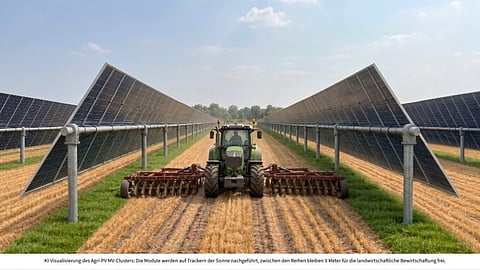


Blue Elephant Energy GmbH (BEE), a Hamburg-based independent power producer (IPP), has secured financing for a nearly 96 MW agrivoltaic project cluster in Mecklenburg-Western Pomerania, Germany. Construction has begun on the three solar parks in Pingelshagen (43 MW), Alt Meteln (33 MW) and Klein Trebbow (20 MW). Commerzbank is providing financing, while GOLDBECK SOLAR is responsible for construction. The project uses tracker-mounted solar modules that follow the sun throughout the day. BEE says this is the country’s largest agrivoltaic project with tracking modules. A 9-meter-wide gap between module rows will allow continued agricultural activities using conventional machinery. The land is expected to remain in agricultural use throughout the project's planned 30-year duration. Commissioning is scheduled for Q3 2027.
Germany-based European energy group Uniper plans to expand its renewable energy portfolio through investments in solar PV, onshore wind, battery storage, and pumped storage projects. The company expects to allocate around 25% to 30% of its planned €6 billion growth capital expenditure to its Green Generation segment through the early 2030s. Uniper has around 570 MW of solar PV and onshore wind projects in development and execution across Europe and the UK. The company said it would pursue selective growth in renewables and hydropower while optimizing its existing assets.
Greece-headquartered HELLENiQ ENERGY has unveiled plans to invest more than €1 billion in Romania by 2030 to expand its solar, wind, and battery energy storage portfolio. The investment program targets a combined renewable energy and storage portfolio of up to 1.3 GW. Through its subsidiary HELLENiQ Renewables, the company says it has developed a Romanian portfolio exceeding 800 MW of renewable energy capacity and 500 MW of battery energy storage system (BESS) capacity. Its existing portfolio includes four solar PV parks with a combined capacity of 211 MW in Teleorman, Giurgiu, Olt, and Dolj counties. By 2030, it aims to have 1 GW of renewable energy capacity and 500 MW of battery storage operational in the country. HELLENiQ ENERGY expects its total investments in renewable energy and storage to exceed €2 billion by 2030 as part of its broader expansion strategy across Southeast Europe. Its current renewable energy portfolio exceeds 6 GW, with more than 800 MW in operation.
Portugal-based EDP has completed its Pracana hybrid renewable energy project in central Portugal. The project combines a 48 MW ground-mounted solar PV plant with an existing 41 MW hydropower plant, bringing the complex's total installed capacity to 89 MW. The solar facility comprises around 90,000 modules and is expected to generate 87 GWh of electricity annually. Combined with the hydropower plant, which has operated since 1951, the complex is expected to generate approximately 140 GWh of renewable electricity per year, shared EDP. The two facilities share existing grid connection infrastructure, the company said, allowing it to increase renewable electricity generation without requiring a new grid connection or additional maximum grid injection capacity. The hydropower plant also provides operational flexibility to complement solar generation, it added.
Austrian electricity company VERBUND AG has raised €600 million through its second European Green Bond issuance of 2026. The eight-year bond was issued under the European Green Bond Standard, with proceeds earmarked for renewable energy, electricity grid, and storage projects across Austria, Germany, Spain, Italy and Romania. VERBUND said the funds will support investments in renewable electricity generation from hydropower, wind and solar PV, alongside high-voltage grid infrastructure and energy storage capacity, particularly pumped-storage hydropower plants. The bond attracted orders worth approximately €2.5 billion, making it 4.1 times oversubscribed, with 129 investors participating.
Signet Bank of Latvia has provided €9.1 million in financing to SIA Jūrmalas SES for a hybrid renewable energy project near Riga, Latvia. The project, being developed by Latvian energy company Aretis Group, will combine a 15 MW solar power plant with a 40 MWh battery energy storage system (BESS). The project will cover 23 hectares and feature nearly 21,000 solar panels. The solar plant is expected to generate around 16,300 MWh of electricity annually, while the battery system will store excess solar electricity and supply it to the grid during periods of higher demand. It will also participate in electricity balancing and frequency regulation markets, providing services to Latvia's transmission system operator, AS Augstsprieguma tīkls. The hybrid energy park is scheduled to become operational in November 2026.