

Germany added around 7.4 GW of solar PV in H1 2026, up 9% YoY, but BSW-Solar says special circumstances supported the increase
BSW-Solar warns proposed EEG and grid policy changes could slow solar growth from 2027, make investments more difficult
It says faster solar and storage deployment remains key to Germany's 215 GW PV target for 2030
Germany installed around 9% more solar PV capacity in H1 2026 than a year earlier, according to the German Solar Association (BSW-Solar). However, the association warned that policy changes and new market barriers could weaken growth from 2027.
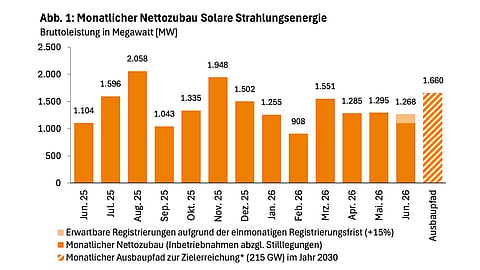
Citing the Federal Network Agency’s (Bundesnetzagentur) Market Master Data Register, the association says around 7.4 GW of new PV capacity was installed during H1 2026, including 1.27 GW in June, up from about 6.8 GW in the same period of 2025. This increase partly reflects ‘special circumstances’ and may not indicate sustained market growth, according to BSW-Solar.
“Currently, we are still on track with the legally mandated expansion. However, this is primarily due to special circumstances. The coming years are not a sure thing,” said BSW-Solar Managing Director Carsten Körnig.
Residential solar demand picked up in recent weeks as households sought greater energy independence amid geopolitical energy concerns, highlighting the ongoing wars in Ukraine and Iran. Additionally, the association points to a pull-forward effect linked to government plans to largely phase out feed-in tariffs for new solar systems from 2027 (see German Alliance Urges Government To Keep Rooftop Solar Support).
Despite the H1 increase, BSW-Solar said the current pace needs to accelerate across market segments to sustainably meet Germany’s 2030 target of 215 GW cumulative solar PV capacity.
The association raised concerns over proposed changes under the EEG reform and the grid package. These include removing EEG support for new systems, introducing direct marketing requirements for smaller building-integrated PV installations and ending compensation for grid-related feed-in restrictions (see Solar, Storage Stakeholders Differ On Germany’s Grid Overhaul).
BSW-Solar said such measures could make solar investment more difficult and slow deployment. It would also impact ‘tens of thousands’ of jobs across the value chain.
“The demand for electricity will increase due to more electric cars, heat pumps, data centers, and air conditioning systems,” Körnig said. “Therefore, the expansion of solar installations on roofs, facades, and open spaces must not be slowed down now.”
Germany currently has more than 6 million PV systems with over 125 GW of combined capacity. Along with around 2.7 million stationary battery storage systems, they cover about one-fifth of the country’s electricity consumption.
BSW-Solar also cited a recent Fraunhofer ISE study that found faster deployment of PV and battery storage could deliver economic benefits. Increased battery storage use could help avoid billions in costs for consumers, businesses and public budgets, according to the study.
Recently, the German government proposed its Reform Package for Recovery and Employment with plans for major reforms to electricity distribution grids. The proposed measures include increasing grid utilization, speeding up digitalization, and expanding smart meter coverage to 90% by 2030.
The package also proposes a lower-cost ‘Smart Meter Light’, greater standardization and transparency on grid capacity, closer cooperation among distribution grid operators, shared software platforms, and connection guarantees for industrial companies. A broader distribution grid package is expected by the end of the year.
