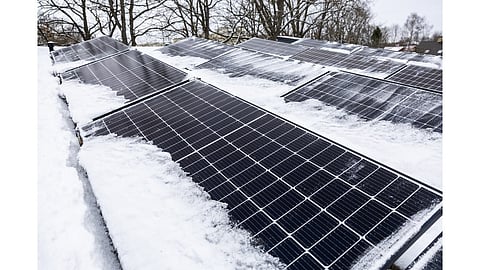


A report by the IEA PVPS finds that despite lower winter sunlight, the Greater Arctic region holds untapped solar PV potential, with around 1,400 MWp installed above 60°N as of 2023
Cold temperatures can improve PV module efficiency and reduce degradation, but projects require customized designs such as bifacial modules and vertical arrays
Snow-aware layouts and frost-resistant foundations are recommended to manage harsh conditions
Policy support, financial incentives, and integration with wind, storage, microgrids, and rooftop self-consumption systems will be key to scaling solar deployment in the region
Bright sunny places are usually the best for solar irradiance and, thus, to generate solar energy, but the Greater Arctic region, with its extreme climatic conditions, also holds untapped potential for solar PV, according to a new report.
Solar energy here can strengthen energy security, enhance resilience in remote communities, and deliver reliable, low-carbon power, according to the International Energy Agency Photovoltaic Power Systems Programme (IEA PVPS).
The Greater Arctic region covers Alaska, Canada, Greenland, the Faroe Islands, Iceland, Norway, Sweden, Finland, and Russia. According to the IEA PVPS, the total installed PV capacity >60°N is estimated at 1,400 MWp as of 2023, assuming that the total installed PV capacity in Russia is primarily concentrated in southern regions.
In its Task 13 report, the IEA PVPS highlights the distinct challenges and opportunities for PV systems in the Greater Arctic region which lies at >60°N latitude. It is known that solar insolation decreases with latitude above 35°N due to lower solar elevation during winters and seasonal variations. However, lower temperatures can lead to higher PV efficiency and lower module degradation rates.
Successful PV deployment in the Greater Arctic region requires a customized approach adapted to its geographic and environmental conditions. For instance, the Nordic nations have power grids present in many high-latitude areas that can help utility-scale installations, but isolated microgrids are more popular in North America.
Catering to this market will require factoring in the local environment, economic viability, and political contexts.
The IEA PVPS recommends using bifacial modules and vertical PV arrays to capture more direct, diffuse, and reflected light. This will also improve snow shedding.
Authors recommend that solar installations in the Arctic include frost-resistant foundations, snow-aware layouts, and adapted system engineering.
For instance, the use of ice-phobic or hydrophobic coatings, steeper tilt angles, and snow fences can mitigate the impact of heavy snow load. At the same time, mechanical snow removal, surface heating, and chemical treatments can be considered. Since these techniques can be expensive or harmful to the environment, the report writers recommend exploring innovative mitigation techniques.
Solar installations can also be integrated with wind power plants, energy communities, virtual power plants, and energy storage, which again require a policy framework around investment tax credits, feed-in tariffs, and net-metering to incentivize PV adoption, according to the report writers.
Rooftop solar systems can work well in self-consumption, thus reducing pressure on the grid. This will need financial incentives and favorable market policies to expand.
“While the region's long summer days provide ample solar radiation for energy harvesting, the harsh winter conditions and logistical hurdles pose significant obstacles to the widespread implementation of PV systems,” reads the report. “Nevertheless, the potential for higher efficiency and longevity of solar modules in colder climates, coupled with the decreasing costs of solar installations, positions solar PV as a viable alternative to traditional fossil fuel sources.”
The complete report, titled Photovoltaics and Energy Security in the Greater Arctic Region 2026, is available for free download on the IEA PVPS website.
