

Solar PV and wind capacity are set to grow through 2035 across all IEA scenarios, with the strongest expansion under the NZE
The combined annual wind and solar capacity additions exceed 1.7 TW by 2035, while battery storage additions reach around 455 GW under the NZE
The share of renewables in the global electricity generation is projected to reach 45% to 50% by 2035 under the Current Policies and Stated Policies scenarios
Solar PV is set to drive renewable energy growth through 2035, as the ‘largest’ energy supply shock in the world’s history pushes countries to diversify their energy supplies and reduce dependence on imported fossil fuels, according to the International Energy Agency (IEA).
In its report, World Energy Outlook 2026 (WEO 2026), the IEA says the global energy crisis triggered by disruptions to oil and gas supplies through the Strait of Hormuz could accelerate the shift toward renewable energy, battery storage, and electrification.
Renewables are set to be the biggest beneficiaries from the global pivot towards domestic energy resources in all of the report’s scenarios. Solar PV, followed by nuclear power, will lead this shift as countries seek energy security and affordability, the report says.
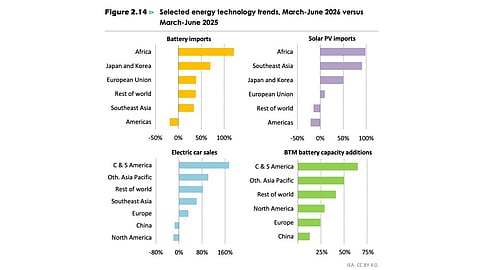
According to the report, oil and gas supply shocks are accelerating solar PV, battery, and EV adoption in many countries in 2026, compared to 2025. It cites available sales and trade data to show there was a sharp uptick in imports of batteries and solar PV equipment over the period, especially in some of the worst-affected countries and regions.
The report also points to rising demand for solar modules and batteries in countries across Asia and Africa affected by the energy crisis. Trade data for 2026 show increased imports of both technologies.
Oil & gas importing regions are especially seeing an uptick in clean energy deployment, and the trend is most visible in the Additional Response Case (ARC) scenario. However, the report writers remark, “While the acceleration in clean technology deployment is noticeable across all scenarios, particularly in fuel-importing regions, it remains well below the pace required in the NZE Scenario.”
Solar PV capacity grows rapidly to 2035 in all scenarios, and so does wind energy. Growth is strongest in the Net Zero Emissions (NZE) scenario. By 2035, in the NZE scenario, the combined share of wind and solar capacity additions exceeds 1.7 TW, and battery storage additions reach around 455 GW. The report also sees growth for nuclear power under the NZE scenario, with annual deployment reaching around 60 GW by 2035.
Solar PV generation increased by 600 TWh in 2025, marking the third-largest annual increase ever recorded for any energy source. The IEA expects renewables’ share of global electricity generation to rise from 33% currently to 45% to 50% by 2035 under its Current Policies Scenario (CPS) and Stated Policies Scenario (STEPS).
Global electricity demand has grown by an average of 3.3% annually since 2019, faster than economic growth and twice the rate of overall energy demand growth. Demand is expected to increase by more than 10,000 TWh over the next decade, driven by industrial electrification, electric vehicles, air conditioning, heat pumps, and data centers.
The report expects electricity’s share of final energy consumption to approach 30% globally by 2035, compared with 23% in 2025, under the CPS and STEPS.
It estimates that at least 25 million km of new power lines will be needed over the next decade, while another 15 million km of existing lines will require replacement or upgrades. It also highlights battery storage and demand response as important technologies for improving grid flexibility and keeping electricity affordable.
However, energy security concerns could keep coal in the energy mix for longer, particularly in Asian countries with domestic coal resources.
While coal demand has grown since the start of the crisis, the IEA expects global coal demand to decline by 2030 across all its scenarios. China is central to this shift as it meets peak demand with renewables and nuclear rather than coal.
While the crisis could accelerate the adoption of low-emissions technologies, the IEA cautions that energy security measures alone will not deliver climate goals. Its scenarios show that emissions reductions remain insufficient to meet the 1.5°C climate target without stronger action.
The IEA stresses that its scenarios explore possible energy futures rather than provide forecasts, with the scale of the changes depending largely on how long the current crisis persists and how governments respond.
IEA Executive Director Fatih Birol cautions, “In pursuit of greater energy security, countries must take care not to replace one dependency with another. But encouragingly for the future, energy security and energy transitions have never been so closely aligned.”
The complete report is available on the IEA’s website for free download.