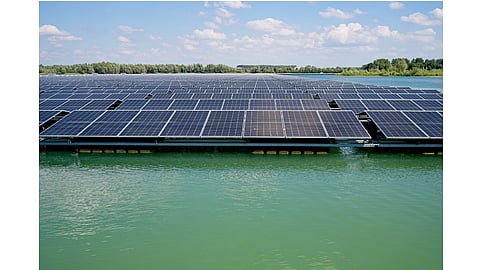


In a new report, NISE estimates India’s floating solar PV potential at more than 102 GW
The assessment considered hydrological, solar resource, and infrastructure-related parameters to identify suitable sites
The government is now preparing a dedicated floating solar scheme to support future deployment
India could deploy over 102 GW of floating solar PV (FSPV) capacity on its reservoirs and inland water bodies, according to a new assessment by the National Institute of Solar Energy (NISE). This raises the country's total evaluated solar potential to 3,445 GW.
It comes as the government prepares a dedicated scheme to support floating solar deployment.
The study highlights FSPV as a significant untapped renewable energy resource, and a promising way to expand renewable energy generation while reducing pressure on land resources. According to the report, worldwide floating solar capacity reached around 9.6 GW by 2024, with annual additions of 1.0 GW to 1.2 GW. Asia-Pacific markets, including China, India, South Korea and Japan, have so far led this growth.
For India, NISE analysts arrived at the 102.18 GW FSPV potential by assuming the use of 545 W solar modules with 21% efficiency and a 5-degree tilt angle. NISE estimated that 0.019 km² of water surface would be needed for every 1 MW of installed floating solar capacity.
NISE says it used a geospatial and data-driven methodology to identify suitable locations for floating solar development. The assessment combined information on water body size, year-round water availability, water depth, solar irradiation, and proximity to roads and substations.
As per the assessment, only water bodies with continuous water availability and depths between 3 and 30 meters were considered suitable. Areas were also required to receive at least 4.5 kWh/m²/day of global horizontal irradiance (GHI). To ensure practical deployment, sites had to be located within 10 km of both road networks and substations. To avoid overestimating the resource, NISE says it excluded water bodies smaller than 10 hectares. It also limited solar deployment to a maximum of 20% of each water body's total surface area.
The report found significant regional differences in floating solar potential. Maharashtra emerged as the leading state with 16.28 GW of estimated potential, followed by Madhya Pradesh with 14.89 GW and Karnataka with 13.69 GW. Other states with substantial potential include Odisha, Telangana and Gujarat.
According to NISE, floating solar can complement ground-mounted solar projects by utilizing underused water surfaces, and reducing algae growth. The technology can also offer additional benefits, including reduced water evaporation and improved solar module performance due to the cooling effect of water. Additionally, these can be a new source of revenue.
NISE says the assessment provides a foundation for future policy development, infrastructure planning and investment decisions.
Released by the Union Minister for New and Renewable Energy Pralhad Joshi, the report Floating Solar PV Potential Assessment 2026 is available on NISE’s website.
